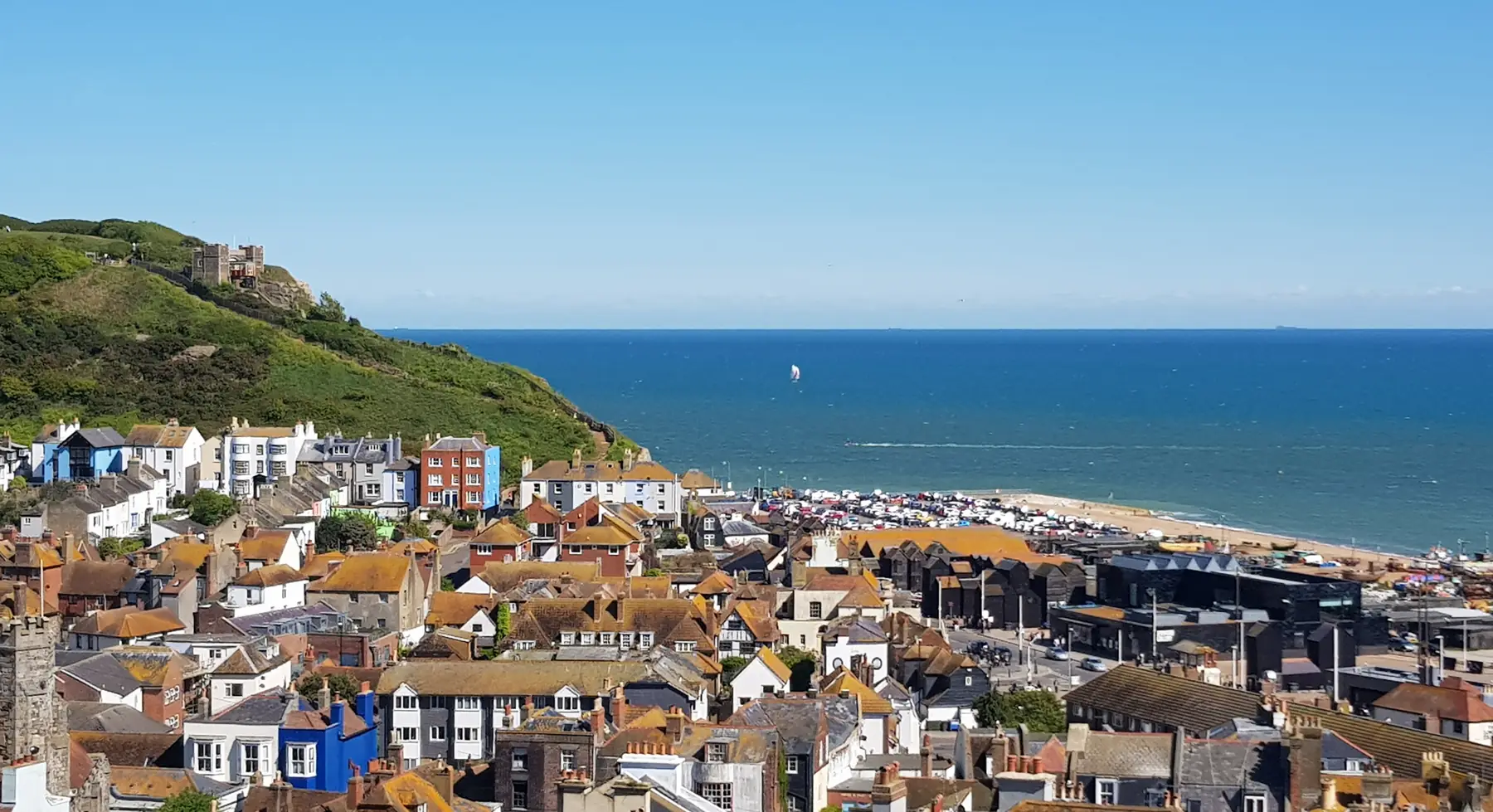
The Battle of Hastings was not fought at Hastings. It was fought thirteen kilometres inland, on a ridge that had no name worth recording, and the town that now stands there is called Battle because the battle is the only reason it exists.
That is the first thing to understand before visiting, and it explains why the abbey and the battlefield are a separate trip from the town rather than a walk along the seafront.
In January 1066 Edward the Confessor died without an heir and Harold Godwinson took the English throne. Two rivals moved against him: Harald Hardrada of Norway, who landed in Yorkshire, and William, Duke of Normandy.
Harold marched north, destroyed the Norwegian army at Stamford Bridge on 25 September, and then learned that William had landed at Pevensey on 28 September. He marched his army back south — some 400 kilometres in a fortnight — gathered what forces he could, and took up a position on a ridge blocking the road to London.
The battle was fought on 14 October 1066 and lasted most of the day, which was unusually long for a medieval engagement. Harold’s army held the ridge in a shield wall; William’s cavalry and archers attacked repeatedly. The English line broke, according to the traditional account, when parts of it pursued a feigned Norman retreat downhill and were cut off.
Harold was killed. Whether by an arrow in the eye — the Bayeux Tapestry is ambiguous and the caption may refer to a different figure — is still argued over. What is not in doubt is that England had a Norman king by Christmas, and the country’s language, landholding, architecture and ruling class were remade within a generation.
William founded an abbey on the battlefield, reportedly on the Pope’s instruction as penance for the deaths, and reportedly with its high altar placed on the spot where Harold fell. Building began in the 1070s. It was a Benedictine house dedicated to St Martin of Tours, and it functioned until Henry VIII dissolved it in 1538.
What survives is substantial rather than complete: the great gatehouse on the town’s high street, one of the finest in England; ranges of monastic buildings including the dormitory undercroft; the outline of the church; and the marked spot of the high altar, where a stone commemorates Harold.
Much of the rest was converted into a country house after the dissolution, and part of the site is now occupied by a school, which is why the visitor route takes the shape it does.
This is the part that catches people out, in a good way. The battlefield itself is open ground below the abbey, and you can walk it.
A path runs around the perimeter of the field, dropping from the ridge where the English line stood to the boggy ground at the bottom where the Normans formed up, and back. There are viewing points, information boards and — the thing that makes it work — an audio tour that positions you at the right places at the right moments in the day.
Standing on the ridge and looking down the slope that the Norman cavalry had to climb, repeatedly, for six hours, tells you more than any amount of reading. Visitors consistently say this is the part they remember.
Allow an hour and a half for the battlefield walk on top of the abbey and the exhibition.
Run by English Heritage, with a modern visitor centre, an exhibition, a film, a shop and a café. Members go free.
Allow half a day — two to three hours for the abbey, exhibition and battlefield, more if you take the town in as well.
The audio tour is worth taking. It is included, it is well made, and the battlefield is much less legible without it.
Terrain. The battlefield walk is grass and can be muddy; there is a slope. The abbey ranges involve steps.
Events. English Heritage runs re-enactments and living history through the year, and a full-scale battle re-enactment around the anniversary in October, which is a considerable production and books out.
The abbey gatehouse stands at the top of the high street, and the town below it grew up to serve the monastery. It is a good high street — pubs, antique shops, cafés, a small local history museum — and it makes a pleasant hour before or after the abbey.
Battle Great Woods on the edge of the town has waymarked walks in ancient woodland.
Battle is one point on a route you can follow.
Pevensey, thirty kilometres west, is where William landed on 28 September 1066 — inside the walls of a Roman Saxon Shore fort, which he promptly fortified. The Norman castle inside the Roman walls is still there.
Hastings Castle, on the West Hill above the town, was built immediately after the landing as William secured his base; the Bayeux Tapestry shows a castle being raised at Hastings.
The 1066 Country Walk is a waymarked long-distance path linking Pevensey, Battle and Rye, thirty-one miles in total. The Battle to Hastings section, about sixteen kilometres through the High Weald, is a good day’s walk with a train back.
By train: Battle is on the London Charing Cross line, twenty minutes from Hastings, with services every half hour. The station is a ten-minute walk from the abbey.
By car: ten kilometres north on the A2100, around twenty minutes, with parking in the town.
On foot: the 1066 Country Walk, about sixteen kilometres, taking four to five hours.
Most of what people picture when they think of 1066 comes from a seventy-metre embroidered hanging made within a couple of decades of the battle, probably in England, probably for William’s half-brother Odo of Bayeux. It is a Norman account, and it is the closest thing to contemporary reportage that survives.
Several of its scenes map directly onto places you can visit from Hastings. The fleet crossing the Channel; the landing at Pevensey; the raising of a castle at Hastings; the feast before the battle; the fighting itself; and the death of Harold under the words Harold rex interfectus est.
Knowing the sequence before you walk the battlefield makes the walk considerably better, and the visitor centre at Battle covers it well.
If the 1066 story is why you came, three more places complete it. Pevensey Castle, thirty kilometres west, is where William landed inside a Roman fort. Hastings Castle, on the West Hill above the town, is the base he built immediately afterwards. And Winchelsea and Rye, east along the coast, are the Cinque Ports that grew out of the Norman settlement of this coast — and, in Winchelsea’s case, were planned from scratch by Edward I two centuries later.
The 1066 Country Walk links Pevensey, Battle and Rye on foot in thirty-one miles, which is the most satisfying way to see the whole thing if you have three days.
Midweek and out of season for a quiet battlefield — the field is at its most affecting when there is nobody else on it.
Spring and autumn for the light and the ground conditions; the battlefield walk is grass and gets muddy in winter.
Mid-October, around the anniversary, for the full re-enactment, which is a substantial event with hundreds of participants and books out well ahead. The town fills, so plan accommodation and parking.
Winter has the shortest opening hours, and some English Heritage sites reduce to weekends only — check before travelling.
At Senlac Hill, thirteen kilometres inland from Hastings, at the place now called Battle. The abbey stands on the site.
Yes — a marked route runs around the field below the abbey, with an audio tour that follows the course of the day.
Two to three hours for the abbey, exhibition and battlefield walk; half a day with the town.
The Bayeux Tapestry is ambiguous and historians disagree about which figure the caption refers to. He was certainly killed in the battle.
Twenty minutes by train from Hastings station, with services every half hour, or twenty minutes by road.