Battle is a town and civil parish of 6,800 people at the 2021 census, in the district of Rother, and it is the trip out of Hastings for the reason Hastings is known at all. The battle of 1066 was not fought in Hastings. It was fought here, and afterwards William, Duke of Normandy, ordered an abbey built on the ground to commemorate the victory and atone for the resulting slaughter. A settlement probably stood outside the abbey gates by 1110, and for some 250 years official documents called the town Bellum, or Bataille in French.
The straight-line distance from Hastings is 10.1 km. Hastings to the south-east of the town but gives no road distance between the two; it does put Battle 50 miles (80 km) south-east of London and 27 miles (43 km) east of Brighton.
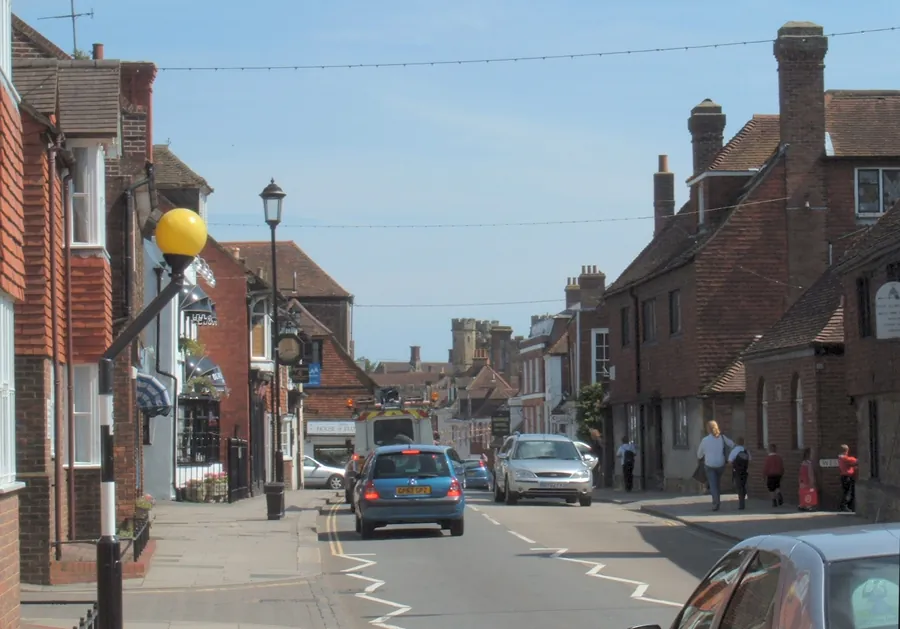
This is inland, wooded country: the town sits in the High Weald National Landscape and forms part of 1066 Country, the destination brand for the eastern side of East Sussex. The High Street is the old-fashioned sort, shops and restaurants down both sides.
The abbey was dedicated in 1095 to St Martin, built by monks from Marmoutier in France, and the high altar of its church was reputedly sited on the spot where Harold died. Much of it has gone, demolished or adapted for domestic living; the surviving cloisters and part of the west range were leased to Battle Abbey School after the First World War, and the school is still there. What dominates now is the gateway, at the south end of the main street.
English Heritage runs the site — battlefield, abbey ruins, gatehouse, visitor centre and exhibitions — and stages a re-enactment of the battle there. The pack lists it twice under two Google names, Battle Abbey at 4.6 from 4,576 reviews and English Heritage - 1066 Battle of Hastings at 4.7 from 1,108, and reviewers under both describe the same thing: a walk over the field with a commentary in your ear. A visitor in July 2026 wrote, “It was a beautiful walk around the historic battlefield accompanied by an excellent free audio guide all about the battle.” Another, the same month: “you can access audio descriptions on device or phones via qr code.”
Every review the pack holds for Battle is four or five stars, so it carries no warning about crowds, parking or an open field in the rain.
Opposite the abbey is the church of St Mary the Virgin, consecrated in 1115. It holds the alabaster tomb of Sir Antony Browne, first occupant of the abbey after the dissolution of the monasteries under Henry VIII, and early 14th-century wall paintings. Two modern pieces answer the abbey across the road: the Senlac window, stained glass depicting the Battle of Hastings, completed in 1984, and the Battle Tapestry, 3.2 m long, modelled on the Bayeux Tapestry, produced by 741 individual stitchers and completed in 2017.
The Battle Museum of Local History stands beside the Almonry, its displays running from prehistoric and Roman finds to the town’s industrial and modern history. It carries 4.8 from 185 Google reviews, the highest rating here on much the smallest sample, and it and the Almonry gardens are free to enter. A visitor in June 2026 wrote, “Very interesting museum, with a lot in there to see for a small place. Also it is free,” and another that month said the volunteers “can either walk round with you or you can look yourself”.
The medieval domestic architecture repays walking slowly: Wealden-style hall-houses in Upper Lake, Pilgrim’s Rest, and others in the High Street.
After the abbey, the woods paid for the town. The area was heavily wooded and supplied oak and other timbers to the navy shipyards, along with power for making cannon — shipped to Portsmouth or Chatham — cannonballs and gunpowder. The first recorded gunpowder mill here was built in 1676, when John Hammond was granted permission to build on land owned by the abbey; the works in Powdermill Lane have since been converted into a hotel. Daniel Defoe described the town in 1722 as “remarkable for little now, but for making the finest gun-powder”.
It was dangerous work: in 1798 more than 15 tons were left in the oven too long and exploded, and after a series of such mishaps the Duke of Cleveland refused to renew the licence in 1874. The town was also known for the skill of its clock and watch makers, including the development of the first ever electric clock, and it was the birthplace in 1799 of Eliza Acton, whose Modern Cookery for Private Families (1845) provided the model for Mrs Beeton’s cookery section.
Close to the parish church stand dragons’ teeth, Second World War concrete anti-tank obstacles put there to hinder an invading force. Powdermill Lane and the battlegrounds turn up in Keane’s “Sovereign Light Cafe”.
On the outskirts, Battle Great Wood is managed by Forestry England for recreation, with woodland access for walking and horse riding. It has 4.6 from 235 Google reviews, and they are practical: a visitor in July 2026 wrote, “Wide easy to follow trails. Lots of shade. Dog friendly.” Parking there is charged by the hour, according to a review in June 2026.
The town also sits on the 1066 Country Walk, 31 miles from Pevensey Castle through Battle and Winchelsea to Rye. Telham Hill, 1.0 mile (1.6 km) south-east of Senlac Hill, is where William first caught sight of the English army forming up, on 14 October 1066; at the top is a mound of uncertain date and purpose. Three Sites of Special Scientific Interest lie in the parish, among them Blackhorse Quarry, which has produced fossil bones and teeth including Iguanodon and crocodiles; they are designations rather than attractions, and the pack says nothing about access.
The train is the direct link. Battle railway station is on the Hastings Line, north of Crowhurst and south of Robertsbridge, managed by Southeastern, which also runs the services; it was designed by William Tess, is Victorian Gothic revival and is listed Grade II by Historic England. A station called Mountfield Halt, between Battle and Robertsbridge, closed on 6 October 1969.
By road, Battle is linked to Hastings and London by the A2100 and the A21. The pack establishes no bus service between the two towns, so check locally rather than assuming one runs.
The village and what is around it, at walking scale.
Open any of them in Google Maps for directions and current opening.
Want live prices and dates? GetYourGuide's booking widget shows them, and sets their cookies in your browser when it loads.
Background on Battle draws on its Wikipedia article, text there being available under CC BY-SA 4.0.