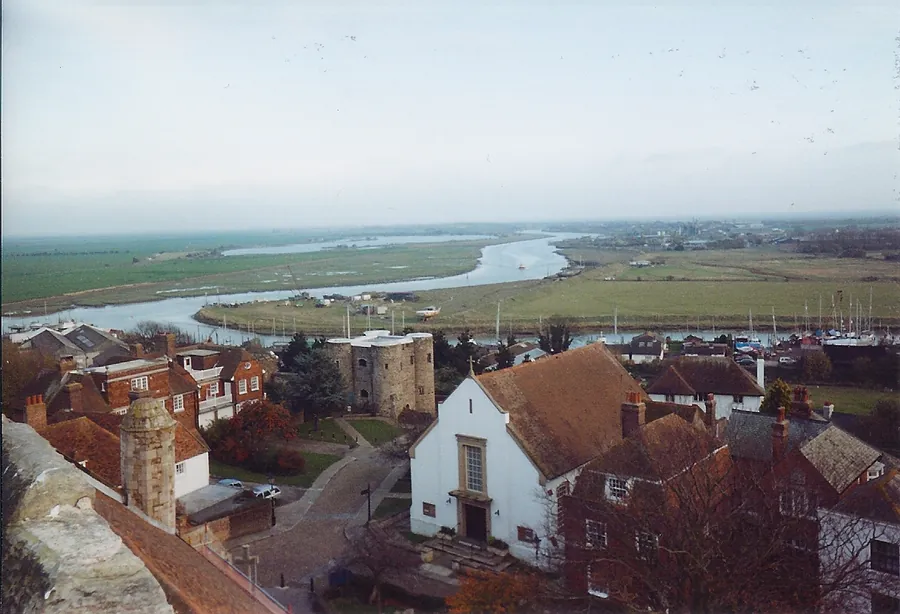
Rye is a town and civil parish in the Rother district of East Sussex, built on a rise of Wealden sandstone where the Rother, the Tillingham and the Brede meet, two miles (three kilometres) from the English Channel. Its population was 4,773 at the 2011 census. In the mid-twelfth century it stood at the head of a Channel embayment, almost entirely surrounded by sea, and was an important member of the Cinque Ports confederation. Storms, silting and deliberate land reclamation have since put the water at a distance.
That retreat is the reason to go. The fortified island port is now a compact hill town whose upper part, the Citadel, still carries the parish church, a thirteenth-century tower, one surviving medieval gate out of four, and the cobbled streets — Mermaid Street, Watchbell Street, Church Square — that most visitors come to walk. Only a minority of Rye’s housing sits up there, so the old core is small, and well used: an estimated one million visits were made in 2016.
The straight-line distance from Hastings is 14.7 km.
Ypres Tower is the oldest thing you can go inside: built in 1249 as Baddings Tower against French raids, later renamed after an owner, John de Ypres. It is now part of Rye Castle Museum, 4.5 from 1,096 Google reviews, and reviewers are clear about its scale: a visitor in May 2026 wrote that “Although small, with only three floors, the women’s tower, and the garden, it’s got a lot packed into it, and from the top floor some incredible views too.” The museum’s second site, on East Street, has 4.4 from 126 reviews.
The Landgate, the last of four fortified entrances, dates from 1329 and takes light vehicles only; in 2015 some 25 tonnes of pigeon excrement had to be cleared from the arch for fear of damaging it. It has 4.5 from 64 Google reviews, too few to weigh heavily. St Mary’s parish church, Norman in origin, has 4.7 from 443, and Rye Heritage Centre 4.5 from 599.
Lamb House, also on the Citadel and National Trust-owned, was Henry James’s home from 1898 to 1916 and later E. F. Benson’s, who made it Mallards and the town Tilling in his Mapp and Lucia novels. Otherwise the walled town is antiques, second-hand books, galleries and restaurants, with markets on Strand Quay and by the station on Thursdays.
The name is thought to come from the West Saxon ieg, island, and Domesday recorded 189 households in 1086. Rye was a limb of the Cinque Ports by 1189 and took its charter from Edward I in 1289, trading tax exemptions for ship service to the crown.
Then the coast moved. Storms in 1250 and 1287 cut the town off from the sea and shifted the Rother’s course; around 1375 sea and river together destroyed the eastern part of town, and ships began unloading at the Strand instead. Two years later the French burnt the town, and the walls were ordered finished. Silting was the long problem, worsened by landowners “inning” the marshes, which cut the tidal flow that had scoured the channel.
The attempt to fix it is a cautionary tale. Work on a new harbour began in 1723; John Smeaton was consulted in 1763 and his advice largely ignored. After 63 years of intermittent building it opened in June 1787 and was abandoned that November. Daniel Defoe had already written that Rye “would flourish again” if the harbour that once took the royal navy could be restored, and thought it doubtful.
With deep-water ports taking the trade, fishing and smuggling took over. Duties had encouraged it since 1301, and owling — the illegal export of wool — was the staple before luxury goods made the business violent. The Hawkhurst Gang met at the Mermaid Inn, whose cellars date from 1156 and which is said to be joined to the Olde Bell by a secret passage; gang members were eventually hanged. The town kept the props: the gibbet cage that displayed the murderer John Breads in 1742, and a pillory last used in 1813.
The Mermaid Inn works as a hotel, bar and restaurant now, 4.6 from 2,258 Google reviews, and those reviews split between the building and the rooms. A visitor in August 2026 called it an “Amazing historic hotel” and then added, “Sadly room was tired and not the cleanest, especially the bathroom.” The highest-rated of these places is not historic at all: Rye Waterworks Micropub, 4.9 from 1,734 reviews, dog friendly, and odd enough that a visitor in August 2026 noted “you can buy everything there. Tables, chairs, decorations, tableware”.
The working harbour lies about 2 miles (3.2 km) downriver. Rye Harbour Nature Reserve, within the Rye Harbour SSSI, is the half-day out here: 4.7 from 1,261 Google reviews, with marsh, a coastal walk, a small café and a path leading to the beach. A visitor in July 2026 wrote, “Free car park but STRONGLY recommended you donate a fee in the donations box.” Another that month warned that the paths are shared with cyclists and that “it gets too windy which makes it less ideal”.
It is a memorial as well. In 1928 the lifeboat Mary Stanford sank with all hands, drowning 17 men, the worst RNLI disaster involving a single vessel, marked by the memorial at Rye Harbour church and by a folk song. A small fishing fleet still lands daily, registered RX for Rye, Sussex — the lettering Hastings boats carry too.
The train is simplest. Rye is on the Marshlink line between Hastings and Ashford, with an hourly service from Eastbourne to Ashford International; the whole Ashford International to Hastings run takes 40 minutes, via Rye and Winchelsea.
By bus, the Stagecoach 100/101 between Dover and Hastings runs half-hourly through the town; by road it is the A259. National Cycle Network Route 2 runs east from Hastings to Rye, though hire is at the far end — Rye Bay Ebikes 15.0 km out and Harbour Cycles at Rye Harbour 15.7 km. On foot, the Saxon Shore Way passes through Rye on its way to Hastings, and the 1066 Country Walk starts here for Pevensey.
One date to plan around: the Rye Bonfire, on the second Saturday after 5 November, draws over 10,000 people, and the roads to Hastings, London and Ashford are clogged and closed from early evening.
The village and what is around it, at walking scale.
Open any of them in Google Maps for directions and current opening.
Want live prices and dates? GetYourGuide's booking widget shows them, and sets their cookies in your browser when it loads.
Background on Rye draws on its Wikipedia article, text there being available under CC BY-SA 4.0.