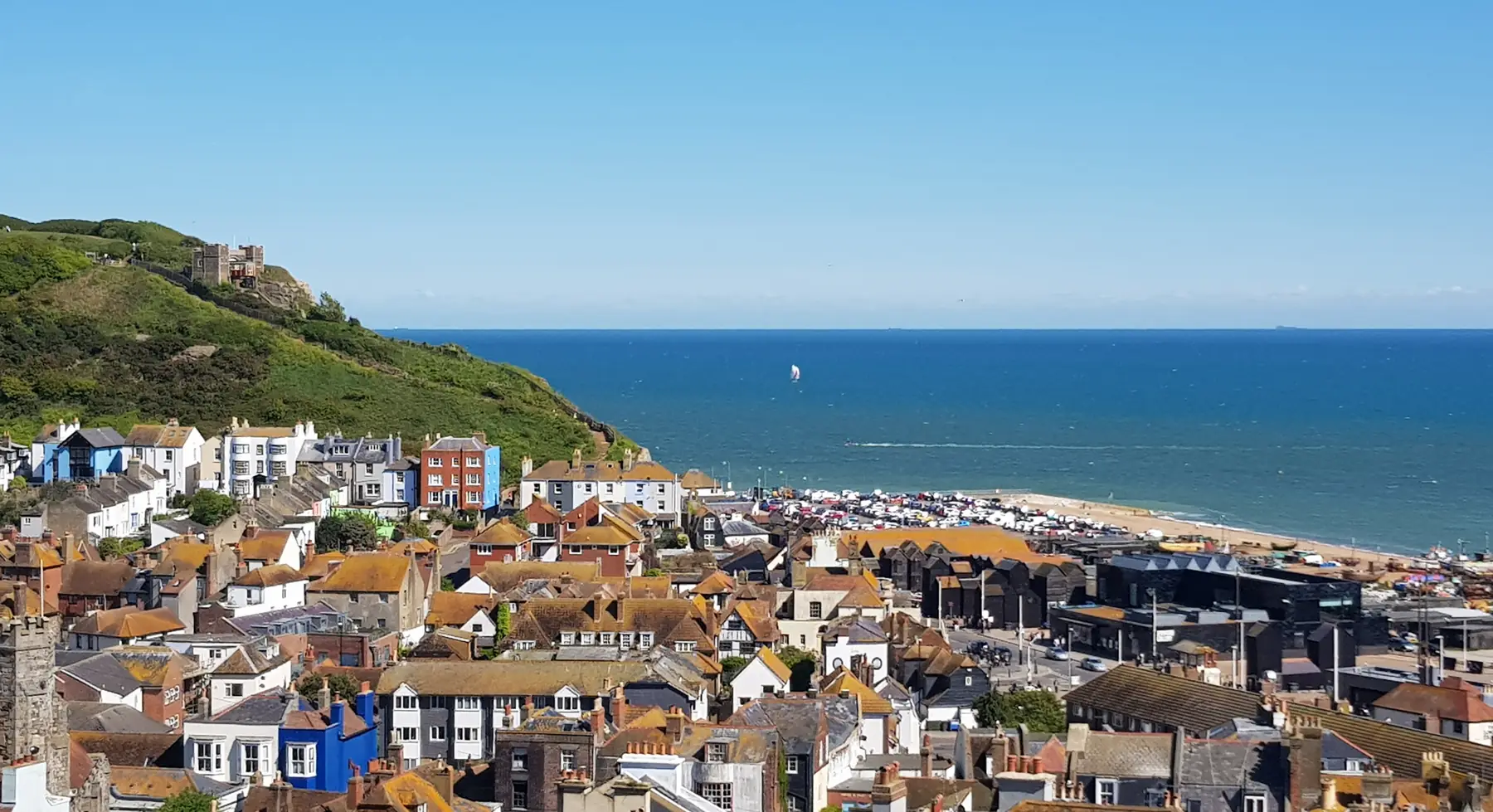
Hastings is the cheapest seaside town in the south-east to spend a day in, and it is not close. Three of its museums are free, the Old Town costs nothing to walk round, the beach and the fishing fleet are free, the two hills above the town are open ground, and the country park east of it is a national nature reserve with no admission at all.
The town’s reputation for being run down is part of the same story. Hastings never gentrified in the way Brighton did, and while parts of the seafront show it, the effect on prices is entirely to the visitor’s advantage.
The eastern end of the beach is a working fishing beach — the largest beach-launched fleet in Europe, operating without a harbour because the medieval one was swept away by the sea. Boats are winched up the shingle, gear is stacked around them, and among it all stand the net shops: tall, narrow, tarred black timber towers, built in the nineteenth century to dry nets in a place where ground rent was charged by area.
There is nothing else like them in Britain. They are free to walk among, they are best in the early morning when the boats come in, and the fish stalls beside them sell what was caught that day.
Hastings Fishermen’s Museum on Rock-a-Nore, in an old fishermen’s church, houses the last Hastings sailing lugger and tells the story of the fleet. Free.
The Shipwreck Museum, next door, is full of material salvaged from wrecks along this coast, including the Amsterdam — a Dutch East Indiaman that grounded in 1749 and still shows in the sand at the lowest tides. Free.
Hastings Museum and Art Gallery on Bohemia Road has the local and natural history collections and the Durbar Hall, an elaborately carved Indian interior brought from an 1886 exhibition. Free.
That is three genuinely good museums for nothing, which very few English towns can offer.
Free, and the reason to come. The valley between the two hills holds a medieval and Georgian townscape that survived because the Victorian resort was built to the west of it: the High Street and All Saints Street running parallel, linked by twittens — narrow passages and flights of steps — with timber-framed houses, hidden gardens, antique shops and a great many pubs.
St Clement’s Church and All Saints Church are both open and free. St Mary in the Castle, the Georgian church built into the cliff on the seafront, is now an arts venue.
The West Hill is open grassland above the Old Town with views along the coast. The castle ruins on it charge, but the hill itself does not, and the view is the same.
The East Hill is bigger, wilder and free, reached either by a stiff climb from Rock-a-Nore or by the cliff railway, which is cheap rather than free. From the top the whole town, the fleet and the Channel are laid out below.
East along the cliffs, free and open: a national nature reserve of sandstone cliffs, grassland and deep wooded valleys — Ecclesbourne, Fairlight and Warren glens — running down to the sea. It is the best free walking on this coast. Only the car park at Fairlight is charged.
Note that the cliffs are soft and subject to landslip; paths are diverted from time to time, so follow current signs.
Alexandra Park, a kilometre inland, is one of the finest Victorian parks on the south coast: sixty-odd acres of lakes, streams and specimen planting, opened in 1864 and remodelled by Robert Marnock in 1877. There are playgrounds, tennis courts, a café and a chain of ponds running up the valley into open country. Entirely free.
St Leonards Gardens, in the neighbouring town, are a smaller and quieter Regency equivalent.
Hastings Pier was rebuilt after a fire in 2010 and won the RIBA Stirling Prize in 2017 for the result — a deliberately open, uncluttered deck rather than a traditional amusement pier. Walking onto it is free.
Bottle Alley, west along the St Leonards seafront, is a covered lower promenade with walls set with broken glass — strange, sheltered and free.
The promenade runs for several kilometres from the Stade west through St Leonards.
Hastings has a strong festival culture and a good deal of it is free to watch. Jack in the Green on the May Day bank holiday weekend is the big one — a revived folk custom in which a figure covered head to foot in greenery is processed through the Old Town and up to the West Hill by several thousand people in green. It is genuinely strange, genuinely popular and completely free.
Bonfire night in the Sussex tradition, the Old Town Carnival Week in August, and a busy programme of seafront events fill the rest of the calendar.
Parking, mainly. Rock-a-Nore for the Old Town and Pelham Place for the centre are the two you will use, and there is a multi-storey at Priory Meadow.
Better, come by train. Hastings has direct services from London Charing Cross every half hour and from Victoria via Gatwick hourly, and the station is a ten-minute walk from the seafront. Rye, Battle, Bexhill and Eastbourne are all short hops from the same station.
Start on the Stade among the net shops and the boats first thing. Do the Fishermen’s Museum and the Shipwreck Museum, both free and both twenty minutes. Climb the East Hill — or pay the small fare on the railway — and walk east into Ecclesbourne Glen and back. Come down through the Old Town twittens in the afternoon, look into the churches and the antique shops, then walk the promenade west past the pier to St Leonards and Bottle Alley. Finish in Alexandra Park.
A full day, three museums, a nature reserve and a fishing fleet, for nothing.
The first free day covered the Old Town and the Stade. The second should go east and up. Take the East Hill on foot — the climb from Rock-a-Nore is steep but short — and walk the clifftop into Hastings Country Park, dropping into Ecclesbourne Glen and climbing out again, then on towards Fairlight if the legs allow. It is free, it is a national nature reserve, and it is genuinely wild country within two kilometres of a town of ninety thousand people.
Come back along the clifftop as the light goes, with the whole town and the fleet below you.
A third free day goes west along the promenade into St Leonards — the Regency planned town built by James Burton in the 1820s, with its own gardens, its own crescents and, along the seafront, Bottle Alley. The Regency architecture in St Leonards is better than anything in Hastings proper and almost nobody looks at it.
Battle Abbey and Pevensey Castle are English Heritage; Bodiam Castle, Lamb House in Rye and Bateman’s are National Trust. None of the free list above needs either, but for a week in 1066 country an existing membership pays for itself quickly.
One more free activity that needs a tide table. At low water the ledges east of Rock-a-Nore, below the East Hill, expose a substantial area of rock pools, and it is one of the better places for it on this coast. At the very lowest spring tides, parts of the wreck of the Amsterdam — the Dutch East Indiaman that grounded in 1749 — become visible in the sand west of the town at St Leonards, which is a genuinely remarkable free sight and one that only appears a handful of times a year.
Check the tide tables, and be aware that the beaches below the cliffs east of the town are cut off at high water.
Three of them are: Hastings Museum and Art Gallery, the Fishermen’s Museum and the Shipwreck Museum.
Tall black timber huts on the fishing beach, built in the nineteenth century for drying nets. They are unique to Hastings.
Yes, apart from the car park at Fairlight.
Not in the centre. Come by train if you can — the station is ten minutes from the seafront.
A revived folk custom held over the May Day bank holiday weekend, with a procession through the Old Town. Free to watch and unlike anything else in England.