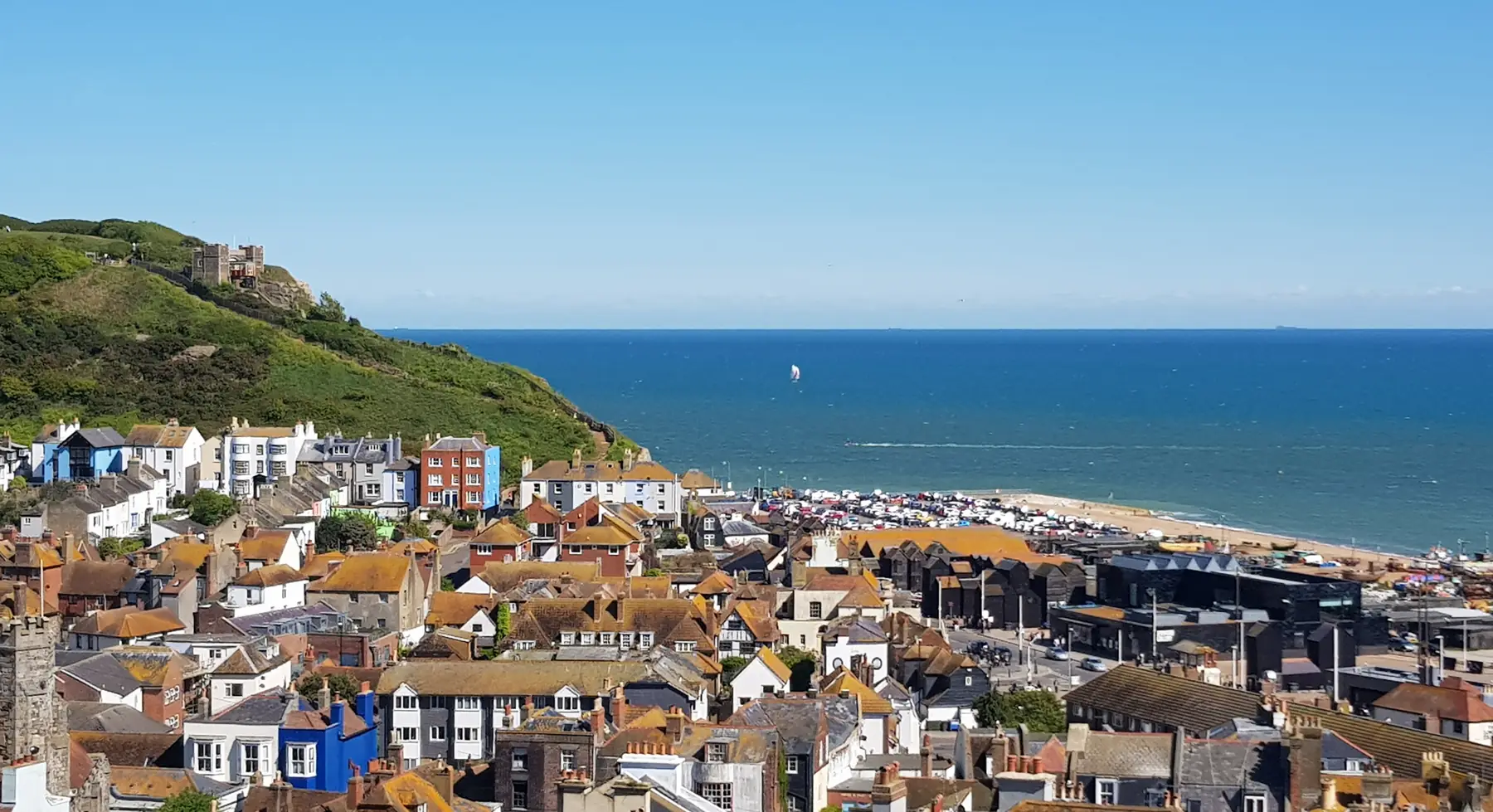
Hastings has an unusual number of indoor things to do for a town of ninety thousand people, and several of them are free. It also has a genuine advantage over most seaside towns in bad weather: a network of sandstone caves under the West Hill, which are dry by definition and considerably more interesting than a shopping centre.
The Old Town helps too. Its lanes are narrow and its buildings lean over them, which means you can move between doorways without getting properly wet — and it is full of antique shops, bookshops and small cafés that do not mind how long you stay.
St Clement’s Caves, under the West Hill, are a real network of tunnels and chambers cut into the sandstone and genuinely used by smugglers in the eighteenth century, when Sussex ran a substantial contraband trade with France. The attraction built into them uses tableaux, sound and lighting to tell that story, and the caves themselves do most of the work.
It is entirely underground, it takes about an hour and a half, and it is the single best wet-weather destination in Hastings. Reach it by the West Hill Lift from George Street.
On Bohemia Road, a twenty-minute walk or a short bus ride from the centre, and free. The collection covers local history, natural history, and a notable Indian collection housed in the Durbar Hall, a carved wooden interior brought from an 1886 exhibition. There is also a good deal on the town’s 1066 associations and its Victorian resort years. An hour and a half.
On Rock-a-Nore, in a former fishermen’s church, and free. It houses the last of the Hastings sailing luggers, plus photographs, gear and the story of a fishing community that still launches its boats off the beach because there is no harbour. Half an hour, and it is the best short introduction to what the Stade is about.
Next door, also free, and full of material recovered from wrecks along this coast — including the Amsterdam, a Dutch East Indiaman that ran aground in 1749 and is still visible in the sand at very low tides. Small, cluttered and rather wonderful.
The black-tiled gallery on the Stade, right among the net shops. It shows modern and contemporary British art, has a strong exhibition programme and a café looking out at the fishing beach. An hour or two, and the building is a good place to watch the weather.
Hastings has a large artistic population and the Old Town reflects it — small galleries, studios, second-hand bookshops and antique shops line the High Street and George Street. On a wet afternoon this is a legitimate activity rather than a fallback.
Hastings Aquarium on Rock-a-Nore, with a walk-through tunnel and a decent collection, is the family answer.
The True Crime Museum, under the seafront, is for adults and older teenagers and is exactly what the name suggests.
Hastings Castle on the West Hill has an audio-visual presentation in a covered space, though the ruins themselves are open to the sky.
The Priory Meadow shopping centre and the seafront amusements cover the practical end.
Battle Abbey, ten kilometres north, has a substantial visitor centre and exhibition and the abbey buildings themselves, plus the battlefield walk, which is worth doing in any weather. Around two hours indoors and out.
Bexhill, eight kilometres west, has the De La Warr Pavilion — a 1935 modernist building on the seafront that is now an arts centre with free galleries, a café and a first-floor terrace with a view of the sea. It is one of the best buildings in the south-east to be inside on a bad day.
Rye, fifteen kilometres east and forty minutes by train from Ashford, has the Ypres Tower and Rye Castle Museum, the heritage centre with its town model, and a dense set of pubs and antique shops in a very small area.
Bodiam Castle, twenty kilometres north, is moated and photogenic but largely roofless — better on a clear day.
Alexandra Park has tree cover and drains well, and the chain of ponds up the valley is at its best under cloud.
The seafront and Bottle Alley — the covered lower promenade at St Leonards, with its broken-glass mosaic walls — is genuinely sheltered and is one of the strangest walks on the south coast.
The Old Town twittens take half an hour and are largely under overhanging buildings.
The clifftop glens in Hastings Country Park are steep, muddy and slippery when wet, and the sandstone is prone to slip. Leave them for a dry day.
Trains put Rye, Battle, Bexhill and Eastbourne all within forty minutes, which makes a wet-day escape easy without a car. London Charing Cross is one hour forty.
Parking at Rock-a-Nore, Pelham Place and the Priory Meadow multi-storey; all fill faster in bad weather because everyone comes into the town.
Opening. Several of the smaller museums have reduced winter hours and some close entirely from November to March. Check before setting out.
The shape that works: Smugglers Adventure in the caves first thing, before the coach parties, which is ninety minutes entirely underground. The West Hill Lift down into the Old Town, and an hour in the twittens, the antique shops and the bookshops, which are largely under overhanging buildings. Lunch in one of the Old Town pubs. Then Hastings Contemporary on the Stade in the afternoon, with the two free museums next door if the gallery is not to your taste, and a coffee in the gallery café watching the weather come across the Channel.
That is a full day indoors within a few hundred metres, with three museums, a gallery and a cave system, and most of it costs nothing.
Hastings’ real wet-weather advantage is the railway. Within forty minutes you can be in Rye (cobbles, pubs, the Ypres Tower), Battle (the abbey and a substantial indoor exhibition), Bexhill (the De La Warr Pavilion, free), or Eastbourne (the free Towner gallery and three theatres). All four are better indoor propositions than a fourth circuit of the Priory Meadow shopping centre, and the trains are frequent.
Two structural reasons, both accidental. The first is the caves: the West Hill is sandstone and it is hollow, and a genuine eighteenth-century smuggling network under a seaside town is a wet-weather asset almost nowhere else has.
The second is the Old Town’s shape. Because it is a medieval town in a valley rather than a Victorian promenade, its streets are narrow, its buildings overhang, and its shops are small, numerous and independent. You can spend two hours moving between an antique shop, a bookshop, a gallery and a pub without ever being more than a few paces from a door. A resort built to a Regency plan — Eastbourne, St Leonards — cannot do that, because its streets are wide and its buildings are set back.
Add three free museums within a hundred metres of each other on Rock-a-Nore and the arithmetic of a wet day here is better than the town’s reputation suggests.
Smugglers Adventure in the caves, the aquarium, Hastings Contemporary, and the free Shipwreck and Fishermen’s museums on Rock-a-Nore.
Hastings Museum and Art Gallery, the Fishermen’s Museum and the Shipwreck Museum are all free.
Yes. St Clement’s Caves are a real network cut into the sandstone under the West Hill, used for smuggling in the eighteenth century.
Yes — a serious exhibition programme in a striking building, right among the net shops and the fishing boats.
A covered lower promenade at St Leonards with walls decorated in broken glass, built in the 1930s. It is sheltered, faintly surreal and free.