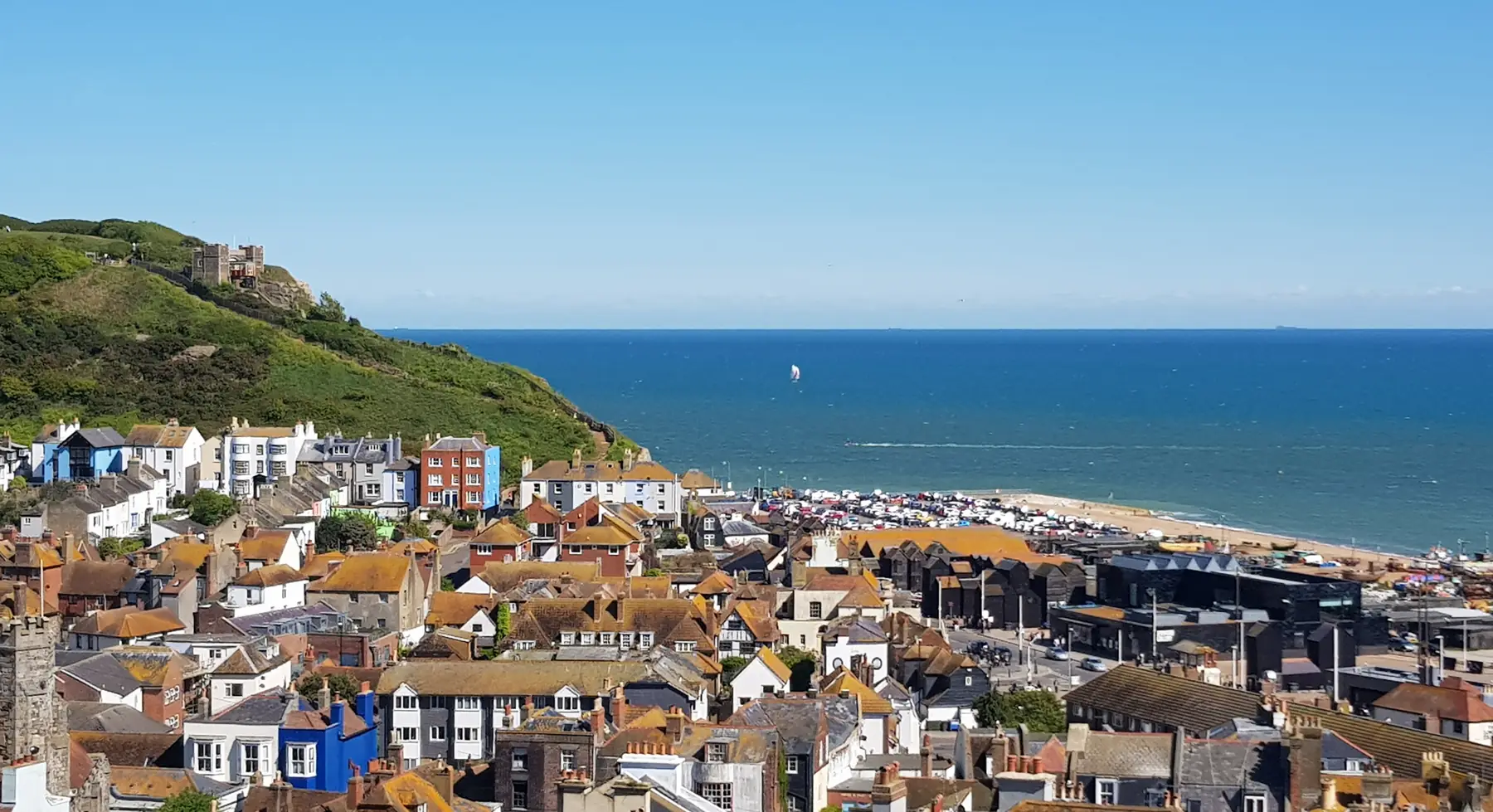
Most English seaside towns have an old quarter that has been tidied into a shopping street. Hastings has something rarer: a medieval town in a valley between two hills, which the Victorian resort was built alongside rather than on top of, and a working fishing beach at the end of it that has been landing fish for a thousand years and still does.
The two things together — the Old Town and the Stade — are the reason to come to Hastings, and they cost nothing to see.
Hastings gave its name to the battle of 1066 but the battle was fought thirteen kilometres inland at Senlac Hill, near the town now called Battle. What Hastings did have was a harbour, which made it one of the Cinque Ports — the confederation of south-coast towns that supplied ships for England’s defence in return for privileges.
In the late Middle Ages the sea took the harbour away. Storms destroyed the works, the shoreline shifted, and Hastings was left as a fishing town with no port. The fleet adapted by launching straight off the shingle, and it has done so ever since.
That is the single fact that explains everything on the beach today.
The Stade — the word simply means a landing place — is the shingle at the eastern end of the seafront where the boats are kept. Because there is no harbour, every boat has to be winched up the beach after each trip, which limits their size: this is a fleet of small inshore boats, and it is the largest beach-launched fishing fleet in Europe.
Go in the morning. The boats come in, the catch is landed, gear is stacked and mended, and the fish stalls beside the net shops sell what arrived that day. It is not a heritage display; it is a working industry that visitors happen to be standing in the middle of.
The tall black towers among the boats are net shops — timber huts, tarred against the weather, built for storing and drying nets and gear. They are unusually tall and narrow because ground on the Stade was rented by area, so the fishermen built upwards. Most date from the nineteenth century, and the earliest arrangements go back much further.
There is nothing else like them anywhere. They are Grade II listed, they are still in use, and they are the most photographed thing in Hastings.
Behind the Stade, the valley between the East and West Hills holds the medieval town. Two streets run parallel up it — the High Street and All Saints Street — linked by a network of twittens, the Sussex word for the narrow alleys and stepped passages that run between them.
What survives is a genuine mixture rather than a preserved set: timber-framed houses from the fifteenth century onwards, Georgian fronts, fishermen’s cottages, hidden gardens climbing the hillsides, and an unusual concentration of antique shops, second-hand bookshops, small galleries and pubs.
All Saints Church at the top of All Saints Street has a medieval doom painting. St Clement’s Church on the High Street has a cannonball lodged in its tower — fired, according to the story, by a French raider, though the details vary with the teller. St Mary in the Castle, on the seafront, is a Georgian church built into the cliff face with a semicircular auditorium, now an arts venue.
The West Hill rises directly behind the Old Town and carries the ruins of Hastings Castle — the first castle William built in England, of which a substantial part has fallen into the sea as the cliff retreated. Under the hill are St Clement’s Caves, a network of sandstone tunnels used by smugglers and now housing the Smugglers Adventure.
The West Hill Lift, a funicular from George Street, saves the climb.
The East Hill is the bigger and wilder of the two, rising straight from Rock-a-Nore at the end of the fishing beach. The East Hill Cliff Railway is one of the steepest funiculars in Britain and lifts you to open grassland with the whole town below, and the path east into Hastings Country Park. See our East Hill Cliff Railway page.
Between them the two lifts are the cheapest good thing in Hastings.
Three sit within a hundred metres of each other on Rock-a-Nore Road, and two are free.
The Fishermen’s Museum, in a former fishermen’s church, holds the last of the Hastings sailing luggers and tells the story of the fleet. Free.
The Shipwreck Museum next door has material from wrecks along this coast, including the Amsterdam, a Dutch East Indiaman that grounded here in 1749 and whose hull is still visible in the sand at the very lowest tides. Free.
Hastings Contemporary, the black-tiled gallery among the net shops, shows modern and contemporary British art and has a café looking out at the boats. Charged, and worth it.
Hastings Aquarium is on the same road.
The Old Town has a strong and slightly eccentric festival culture. Jack in the Green, over the May Day bank holiday weekend, revives a folk custom in which a figure entirely covered in foliage is processed through the streets and up to the West Hill by thousands of people dressed in green, where he is symbolically slain to release the spirit of summer. It is free, it is enormous, and it is unlike anything else in England.
Old Town Carnival Week in August and the Sussex bonfire traditions in the autumn fill the rest of the year.
Parking. Rock-a-Nore car park serves the Stade and the East Hill; Pelham Place is the central seafront option. Both fill on summer weekends.
Getting there. Hastings station is a ten-minute walk from the seafront and about twenty from the Old Town, or a short bus ride along the front.
On foot. The Old Town is steep, cobbled and full of steps. The seafront and the Stade are flat.
Timing. Morning for the fishing beach; late afternoon for the light on the net shops; evening for the Old Town pubs.
Buying fish. The stalls on the Stade sell what the boats landed that morning, and it is both cheaper and fresher than anything you will find inland.
The Stade rewards timing more than almost anything else in this guide. Early morning, when the boats are coming in and the catch is being landed, is when it is a working beach rather than a picturesque one. Late afternoon, when the sun comes round onto the net shops, is when it photographs best. And rough weather, when the fleet stays ashore and the boats are drawn right up the shingle with the sea coming in behind them, is when it looks most like what it is.
The Old Town runs on a different clock: quiet in the morning, busy in the afternoon, and at its best in the evening, when the pubs fill and the lanes empty of shoppers.
A postscript that changes how you see the beach. A large proportion of what the Hastings fleet lands is species the British market has never much wanted — and is exported, particularly to France and Spain. The fleet has also spent decades in a difficult relationship with quota systems designed around large boats, which has been a running political issue in the town.
Buying from the stalls on the Stade is therefore not only cheaper and fresher than buying inland; it is one of the few direct routes from these boats to a local plate.
Net shops — tall tarred timber huts built for drying fishing nets, unusually tall because ground rent on the beach was charged by area.
Yes. It is the largest beach-launched fishing fleet in Europe and it lands fish every day the weather allows.
In the valley east of the town centre, between the East and West Hills, running inland from the fishing beach.
No — thirteen kilometres inland at Senlac Hill, at the place now called Battle.
The East Hill Cliff Railway for the wilder hill and the country park; the West Hill Lift for the castle and the caves. Both are cheap and both are short.