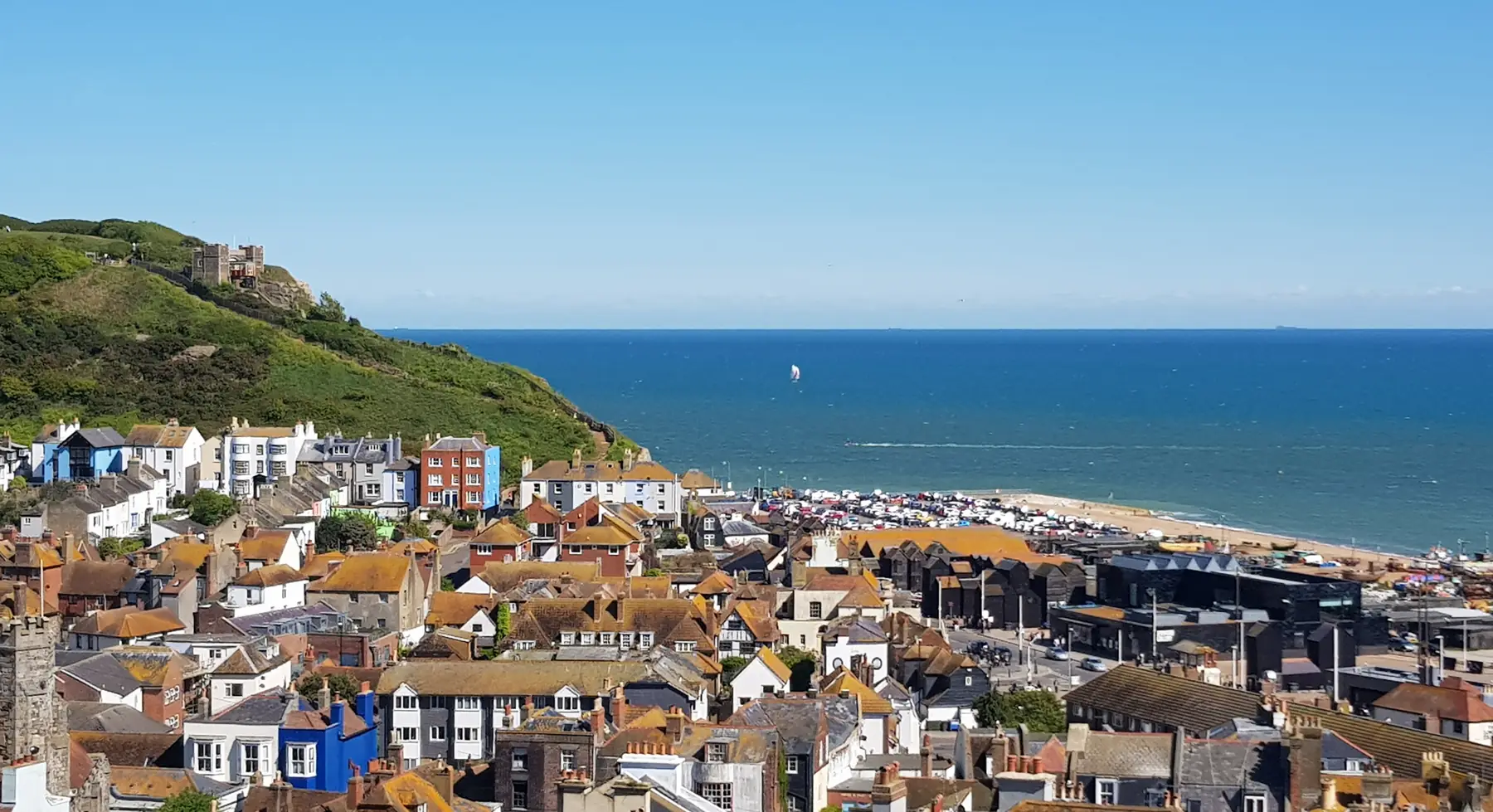
Hastings is well placed for days out and unusually well connected by train. Rye is fifteen kilometres east on a line that continues to Ashford International; Battle and Robertsbridge are north on the Charing Cross line; Bexhill, Eastbourne and Lewes are west. Almost everything below can be done without a car, which is not true of most of rural Sussex.
The roads are the usual Sussex mixture: the A21 north and the A259 along the coast are the arteries, and everything else is lanes.
Fifteen kilometres east, forty minutes by train via Winchelsea. A hill town of cobbled streets and timber buildings that was a Cinque Port until the sea retreated and left it two miles inland. Mermaid Street is the picture; the Ypres Tower and Rye Castle Museum, the church of St Mary with its clock and its climbable tower, and Lamb House, where Henry James lived, are the substance. It is small, extremely photogenic and busy in summer — go early or late.
Rye Harbour Nature Reserve, a couple of kilometres south, is a vast expanse of shingle, lagoons and saltmarsh with hides and a modern discovery centre, and it is one of the best bird sites in the south-east.
Twelve kilometres east. Rye’s quieter neighbour: a planned medieval town laid out on a grid in the thirteenth century, which then lost its harbour and never grew into its plan. What survives is a village inside the outline of a town, with a huge church, three surviving gates and a network of medieval cellars under the houses.
Twenty-five kilometres east. Miles of dunes and flat golden sand — the only genuinely sandy beach in this part of Sussex, and correspondingly busy in summer. Go early, and be aware that the tide comes in fast across the flats.
Ten kilometres north, twenty minutes by train. Battle Abbey stands on the ground where the Battle of Hastings was fought in 1066 — William founded it in penance, with the high altar reportedly on the spot where Harold fell. The English Heritage visitor centre, the abbey buildings, the gatehouse and the battlefield walk together make a half day, and the audio tour is good. Our 1066 guide has the detail.
The town itself has a good high street with pubs and antique shops, and Battle Great Woods on the edge of it.
Twenty kilometres north. The moated castle everybody pictures when they hear the word — square, four-towered, reflected in its own water. It is largely a shell inside, which does not matter at all. There is a boating station on the Rother, and the Kent and East Sussex Railway runs steam trains from Bodiam to Tenterden.
The High Weald National Landscape north of Hastings is one of the best-preserved medieval countrysides in Europe — small irregular fields, ancient woodland, sunken lanes and scattered farmsteads, largely unchanged in outline since the fourteenth century. Robertsbridge, Brede and Northiam are the villages, and Great Dixter at Northiam has one of the most influential gardens in England.
Eight kilometres west, ten minutes by train. The De La Warr Pavilion is a 1935 modernist building on the seafront — one of the first major modernist public buildings in Britain — now an arts centre with free galleries, a café and a sea-facing terrace. Bexhill also has a good museum with a motoring collection: Britain’s first motor race was run here in 1902.
Thirty kilometres west, half an hour by train. Eastbourne has a Victorian seafront kept free of amusements by the Devonshire estate, a pier, and the free Towner gallery. West of it, Beachy Head is the highest chalk sea cliff in Britain and the Seven Sisters run on from there to Cuckmere Haven. A full day, and one of the great coastal landscapes in England.
Seventeen kilometres west. A fifteenth-century moated brick castle — one of the oldest significant brick buildings in England — next door to the Observatory Science Centre in the domes of the former Royal Greenwich Observatory. The two together make a full day and work in poor weather.
Eighteen kilometres west. A Roman Saxon Shore fort with a Norman castle inside it, and the beach where William landed in 1066 before marching on Hastings. It is a ruin rather than a furnished castle.
Brighton is an hour by train, Canterbury an hour and a half via Ashford, and London an hour and forty minutes from Charing Cross. Ashford International, forty minutes away, puts the Eurostar within reach.
Hastings is one of the better-connected coastal towns for this. Charing Cross trains run every half hour, taking about one hour forty, and call at Battle and Robertsbridge on the way. London Victoria services run hourly in two hours via Gatwick Airport, Lewes, Eastbourne and Bexhill. And the Marshlink line to Ashford International runs hourly, calling at Winchelsea and Rye, in about forty minutes.
That single station covers Battle, Rye, Winchelsea, Bexhill, Eastbourne and Lewes, which is most of this list. Buses fill in Camber, Bodiam and the Weald villages.
For getting to Hastings in the first place, see getting here.
The 1066 day, by train. Charing Cross line north to Battle in the morning for the abbey, the battlefield walk and the exhibition; lunch on Battle high street; then back and on to Pevensey by bus or car for the Roman fort and the beach where William landed. The whole conquest in a day, in order.
The Rye and Marsh day, by train. Marshlink line east, stopping at Winchelsea for the medieval grid and the church, then on to Rye for Mermaid Street, the Ypres Tower and lunch. Afternoon at Rye Harbour Nature Reserve, or a bus out to Camber Sands. Home by train.
The Weald day, by car. North to Bodiam Castle for the moat and the boating station, on to Northiam for Great Dixter’s garden, then back through the lanes via Northiam and Brede. Slow roads, ancient countryside and almost no other visitors.
Rye and Camber are both extremely busy on summer weekends and both are much better midweek or early in the day. Battle is steadier. The Weald villages are quiet all year.
The one date to plan around is the anniversary of the battle in mid-October, when English Heritage stages a full re-enactment at Battle and the town fills completely.
A practical note that changes the economics. Almost every destination on this page is on a train line out of Hastings station, and the two coastal lines — Marshlink east to Ashford and the Coastway west to Brighton — are both slow, scenic and cheap.
Day return fares to Rye, Battle, Bexhill and Eastbourne are all modest, and a rover or day ticket covering the area is worth checking if you plan two or more hops. Buses fill in the gaps to Camber, Bodiam, Northiam and the Weald villages, though rural frequencies drop sharply on Sundays.
For a week’s stay without a car, Hastings is one of the easiest bases in the south-east.
Rye for a half day, Battle if you want the history, Camber Sands if you want sand.
Ten kilometres north, twenty minutes by train from Hastings station.
By train to Rye and then a bus, which runs frequently in summer.
Yes, though it is small — half a day is right, and the nature reserve at Rye Harbour makes it a full one.
One hour forty from Charing Cross, or two hours from Victoria via Gatwick.