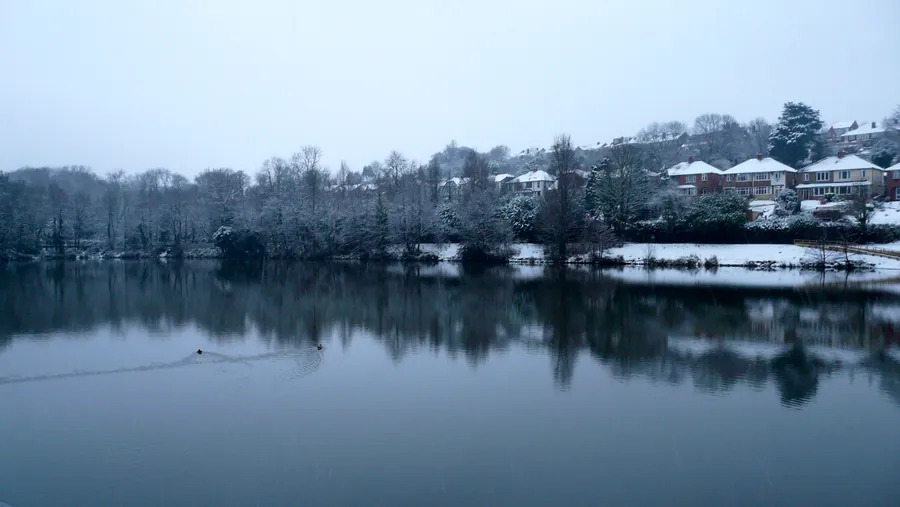
Alexandra Park covers about 109 acres in the middle of Hastings, running north from close to the town centre up a wooded valley for well over a mile.
It opened in 1864 as St Andrews Gardens, was redesigned in 1877 by Robert Marnock — one of the leading landscape gardeners of the Victorian age, who also laid out the Royal Botanic Society’s garden in Regent’s Park and Sheffield Botanical Gardens — and grew by increments into what is there now.
It is free, and it is considerably more than a municipal park.
The park follows a stream valley, and its length is what makes it unusual: it runs from formal Victorian pleasure grounds at the town end, through lakes and open grass, into genuine woodland at the top, so that walking up it is a progression from clipped to wild.
The lower park — formal bedding, specimen trees, a bandstand, tennis courts and the most-used lawns.
The lakes — a chain of ornamental ponds and, further up, the old reservoirs, which now hold coarse fish and are fished under permit. Wildfowl throughout.
The upper park — woodland, rougher grass and wild garden, quieter and less visited.
This is what lifts it. The park holds a nationally significant tree collection — Marnock’s original planting plus a century and a half of additions — and includes champion trees, the largest recorded examples of their species in Britain.
For anyone with any interest in trees it is worth an afternoon on its own, and even without that interest the effect of mature specimen planting through a valley is the reason the park feels grander than its budget.
Two playgrounds, well used and well maintained.
Tennis courts and open grass for football and cricket.
A café in the park, plus kiosks in season.
Toilets — described repeatedly as clean, which for a public park is worth saying.
Fishing lakes under permit.
Events through the summer, including music and community festivals.
It is a residents’ park first, and that is its character: dog walkers, families, groups meeting up, children’s parties on the open grass, people running.
The recurring description from those who use it is that you could spend most of a day there — which is unusual for a town park and reflects the size and the variety. On a hot day the mature trees give real shade, which the seafront cannot.
Free, open at all times, though the formal gates have hours.
Location: the lower entrance is on St Helen’s Road, about a kilometre from the town centre and fifteen minutes’ walk from the seafront.
Parking: on-street around the edges; there is no dedicated car park.
Access: the lower park is level with surfaced paths; the upper park climbs and the woodland paths are rough.
Dogs: welcome, with the usual controls.
Best time: spring for the flowering trees and rhododendrons, autumn for the collection’s colour.
The town centre and the seafront are fifteen minutes south.
Hastings station is close to the lower entrance.
Hastings Country Park — clifftop and glens — is the wilder alternative, east of the Old Town.
About 109 acres, running more than a mile up a valley from near the town centre.
Yes.
It holds a nationally significant collection dating from Robert Marnock’s 1877 redesign, including several British champion trees.
Two, plus tennis courts, open grass and a café.
Yes, in the reservoirs and lakes, under permit.