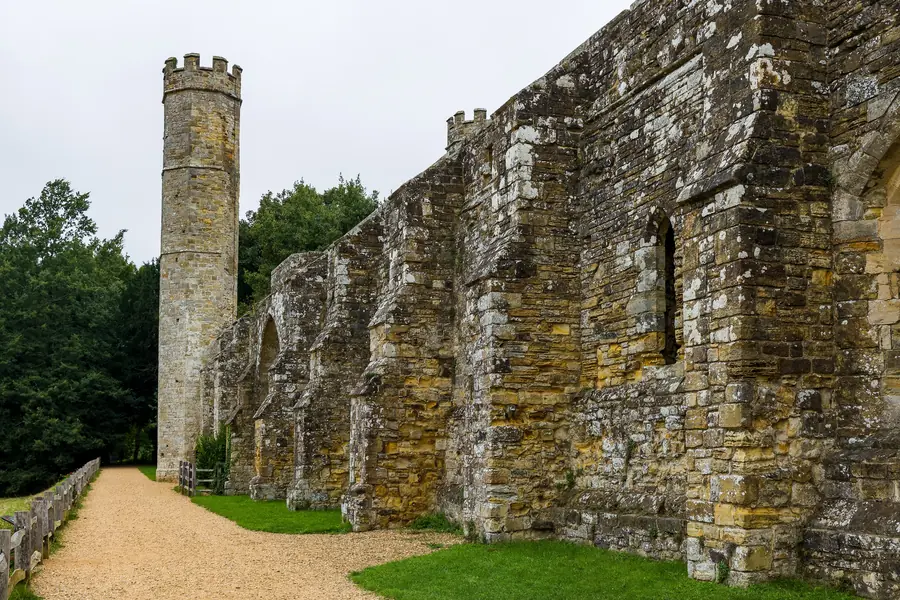
Battle Abbey stands at the head of the High Street in the town of Battle, nine kilometres inland from Hastings, and it exists because of what happened on the ridge it stands on.
After 14 October 1066, William founded a Benedictine abbey here — by the tradition, on the direct instruction of the Pope as penance for the killing, and sited so that the high altar of its church stood on the spot where Harold was killed. It was dedicated to St Martin of Tours, the soldier-saint.
It is a Scheduled Monument, and the abbey is the reason the town of Battle exists at all: it grew up outside the abbey gate.
The Great Gatehouse of 1338 faces down the High Street and is the finest medieval abbey gatehouse in England — battlemented, turreted, and built at a moment when the French were raiding the Sussex coast and the abbey wanted to look defensible. You can go up it, and the roof walk gives a view over the battlefield.
The monks’ range survives substantially: a long thirteenth-century block with the novices’ room, the common room and a superb vaulted undercroft, ribbed and columned, which is the single most impressive interior on the site.
The church is gone — demolished at the Dissolution in 1538, when Henry VIII gave the abbey to Sir Anthony Browne, who pulled down the church and turned the rest into a house. Its plan is laid out on the ground, and a memorial stone marks the traditional position of the high altar and of Harold’s death.
The precinct includes the ice house, the walled gardens and the terrace walk along the top of the ridge.
The rest of the abbey buildings house a school and are not open.
Battle Abbey was one of the richest houses in England and held extraordinary privileges — its own liberty, exempt from the bishop’s authority, with rights of sanctuary and its own courts. The Battle Abbey Chronicle it produced is a major source for post-Conquest England, and also, more entertainingly, an accomplished piece of institutional myth-making: the monks forged charters to extend their privileges and told the story of the foundation in whatever way best served the abbey.
Reading the site with that in mind — a monument built to launder a conquest, then defended by fabricated documents — is more interesting than the simple version.
Admission charged, covering the abbey, battlefield and exhibition; free to English Heritage members. Book online in summer.
Time: two to three hours for the whole site.
Facilities: café, shop, toilets.
Access: the abbey ruins involve steps and uneven ground; the gatehouse roof is up a stair. There is level access to parts of the precinct.
Getting there: Battle station is a five-minute walk, on the Hastings–London line — about fifteen minutes by train from Hastings. By road it is twenty minutes.
Battle High Street faces the gatehouse and is a good one — pubs, tea rooms, independent shops and the parish church of St Mary, built by the abbey in the twelfth century and worth ten minutes.
As penance for the killing at the Battle of Hastings, with its high altar sited on the spot where Harold fell.
No — it was demolished at the Dissolution in 1538. Its plan is marked on the ground with a memorial stone at the high altar site.
The 1338 gatehouse and the thirteenth-century monks’ range, whose vaulted undercroft is the finest interior on the site.
Nine kilometres — fifteen minutes by train from Hastings to Battle station, then a five-minute walk.
Yes, one admission covers the abbey, the battlefield trail and the exhibition.