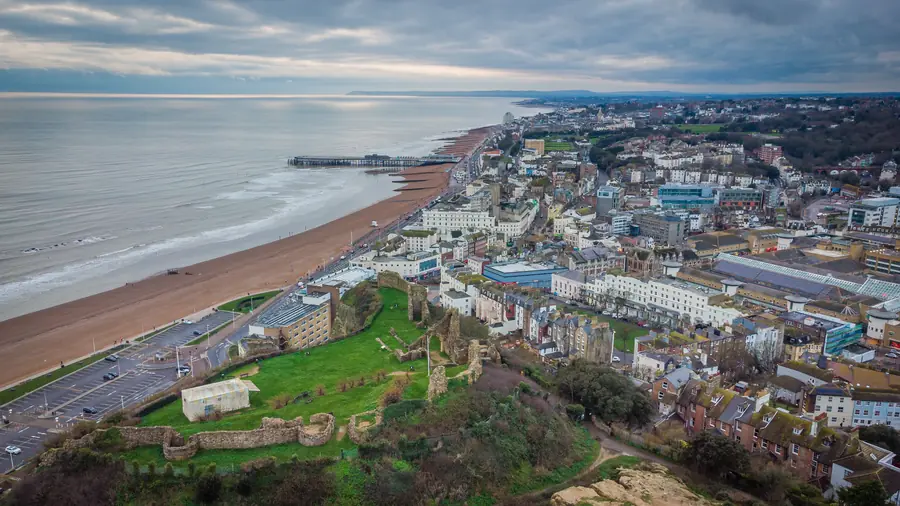
Hastings Castle stands on the cliff of the West Hill, directly above the town, and it has a reasonable claim to being the first castle the Normans built in England.
William landed at Pevensey on 28 September 1066, moved along the coast to Hastings, and threw up a prefabricated wooden castle — shipped across in sections, according to the Bayeux Tapestry, which shows the mound being dug. The stone castle came later, from about 1070.
What survives is a fragment: part of the curtain wall, the eastern gateway, the ruins of the collegiate church of St Mary, and a set of dungeons cut into the rock.
Two reasons, both irreversible.
The sea. The castle was built on a cliff, and the cliff has been going for nine hundred years. Large parts of the castle — including, probably, most of the keep — have simply fallen into the Channel. Great storms in the thirteenth century did much of the damage at once.
King John. In 1216, expecting a French invasion, he ordered the castle slighted so that it could not be used against him. It was partly rebuilt, then declined, and by the sixteenth century it was a farm with a ruin on it.
The site was rediscovered as a romantic curiosity in the nineteenth century, excavated, and opened as an attraction.
It is a ruin, and a small one. Walls, the gateway, the church outline, the dungeons, and an audio-visual presentation — the 1066 Story — in a marquee-style structure telling the events of that autumn.
Allow forty-five minutes to an hour.
The view is the other half of the ticket and is not oversold: the whole sweep of Hastings and St Leonards below, the pier, the beach and the Channel, with benches to sit on. On a clear day it is the best outlook in the town.
Visitors consistently mention the welcome — the person at the gate is knowledgeable and gives a short talk on arrival, which people appreciate.
It is a hell of a climb. The West Hill rises steeply from the town, and doing it on foot on a hot day is a real effort. Visitors say so, repeatedly and with feeling.
The West Hill Lift solves it: a funicular railway running through a tunnel in the cliff from George Street in the Old Town up to the West Hill, close to the castle. It opened in 1891 and it is the sensible way to arrive.
There is also road access and a small amount of parking on the hill.
The castle sits on open grassland that is worth time in itself — the whole clifftop is public, with the Ladies’ Parlour green, views along the coast, and paths down into the Old Town.
Smugglers Adventure at St Clement’s Caves is on the same hill, a few minutes’ walk, and the two are often done together.
Admission charged, modest.
Time: forty-five minutes to an hour.
Access: the site is grass and uneven, with steps; the dungeons are not accessible.
Opening: seasonal — reduced or closed in winter. Check before travelling.
Facilities: a kiosk; toilets on the West Hill.
It has a strong claim — William’s prefabricated timber castle was raised here within days of landing in 1066, with the stone castle following from about 1070.
Coastal erosion has taken much of it into the sea, and King John ordered the castle slighted in 1216.
The West Hill Lift funicular from George Street in the Old Town, or a steep walk. There is limited parking on the hill.
Forty-five minutes to an hour, including the 1066 Story presentation.
Yes — it is the best outlook over Hastings and the Channel, with benches to sit on.