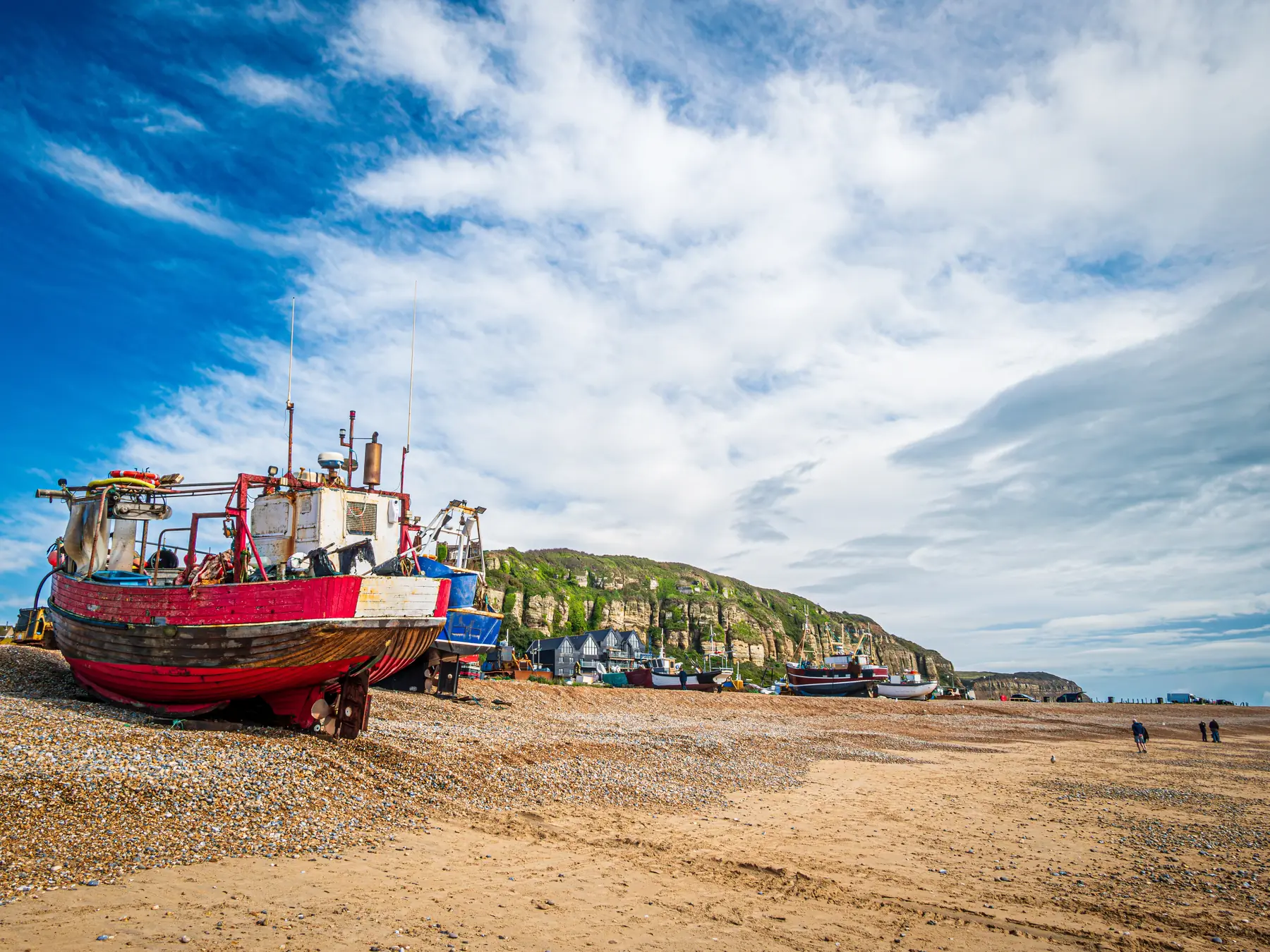
Hastings and St Leonards share one long strand, shingle for most of its length, from the Harbour Arm and the Stade in the east through Pelham and White Rock to Warrior Square and West St Leonards. It is a working beach at one end, a Victorian resort in the middle, and a quieter promenade in the west. It is not a single sandy bay, and it is not the article about the net shops and the fleet — that is the Old Town and the fishing fleet. This is the swimming, tides and where-to-sit piece.
There is no safe assumption of sand at high tide. At low tide, sand shows in places. At high tide you are on pebbles, and the water deepens quickly. That one fact decides more beach days here than the weather does.
The front runs for several kilometres, level on the promenade, steep on the shingle. Groynes of timber and rock split it into rooms. The Harbour Arm — a half-finished Victorian attempt at a harbour the sea never allowed to work — marks the eastern hinge. West of that, the resort. East of that, the Stade.
Walk it and the character changes every ten minutes: fishing gear, the East Hill Lift, Pelham and the pier, White Rock, Bottle Alley, Warrior Square, the Marina. You do not need to see all of it in a day. You do need to know which stretch you meant. The pier, rebuilt after the 2010 fire, is a Stirling Prize deck: deliberately open, free to walk, a viewing platform for the strand rather than a substitute for it.
The Stade is a landing place. Boats are hauled up the shingle because there is no harbour. Nets, boxes, oilskins, capstans and the tall black net shops occupy the ground. Fish is sold from the stalls. This is Europe’s largest beach-launched fleet, and it is still a fleet.
It is not a sunbathing lawn. Do not spread a towel among the gear, climb on the boats, or let children treat a pile of nets as a playground. The fishermen are at work. Morning, when the boats come in, is when it is most itself. Walk through, look, buy fish, then go west if you wanted to lie down.
Rock-a-Nore, immediately east, is still working beach more than resort. The East Hill rises straight off it. Dogs are allowed on this eastern end year-round under the current council rules — the Stade and Rock-a-Nore exclusions were lifted after a public review — but the gear still has priority. Check the signs.
West of the Harbour Arm, through Pelham, is the classic Hastings seaside: promenade, groynes, the pier, miniature golf, kiosks, the crowd. This is where families sit. This is where the flags go up in season. This is where a hot August Saturday looks like a south-coast postcard, pebbles and all.
Sand appears at low tide in patches. It is not Camber. Beach shoes help. The shelf is steep enough that a small child can be out of their depth a few steps from the dry stones. The groynes make windbreaks; they also make the longshore drift visible. Do not swim round the end of a groyne for a quieter patch.
White Rock, further west, is the same strand with fewer ice creams. Falaise Road is the car park for that end if you only wanted a few hours. High tide eats the sitting room. A falling tide in the morning is the comfortable Pelham day. A rising tide on a bank-holiday afternoon is everyone on the same narrowing strip of stone.
St Leonards is the quieter west. Warrior Square, Bottle Alley, the Marina, the long front toward West St Leonards and Bulverhythe. Same shingle, fewer arcades, a different light in the evening.
Bottle Alley — Sidney Little’s 1930s covered lower promenade, walls set with broken glass — is the sheltered walk and the wet-day gift. It is strange and specific and better than a shopping centre. The beach below it is still the Channel.
This is the end to pick if Pelham is a crush and you still want the sea. The promenade is the day’s structure: walk west, sit, walk back. Where to eat covers the St Leonards strip. West St Leonards is quieter again; the borough beach runs on towards the Rother boundary.
The Channel is cold. August is the warmest it gets, and it is still a wetsuit sea for anything more than a dip. People do swim here, year-round in small numbers. That does not make it a lido.
The council puts lifeguards on Pelham and Marina in season, on the flagged areas. Recent listings have them daily 11am–6pm from mid-July into early September. That window moves. The beaches information page is the live list. Swim between the flags when they are flying. Do not assume a flag in June. Do not swim off the Stade among the boats and the winch cables. Do not swim at the Harbour Arm or off the rock groynes for a photograph.
The shelf means depth arrives fast. There can be a longshore drift. Groynes create currents at their ends. If you are not a sea swimmer, paddle and stop. If you are, pick the flagged water. If the flags are down, the answer is no.
Tides matter more here than in a sandy bay with a gentle gradient. High water at Pelham can leave you a steep face of stone and a short walk to the promenade wall. Low water opens sand, rock and, at the very lowest springs, wreck-watching — the Amsterdam, a Dutch East Indiaman that grounded in 1749, still shows in the sand at those tides, which is a Shipwreck Museum conversation and not a swimming plan.
Check a tide table for Hastings before you commit a picnic to a particular groyne. A rising tide against a sea wall is how people get surprised. Some glen beaches east of the East Hill are cut off; stay on the town strand unless you know that foreshore.
The Harbour Arm is a walk and a fishing platform, not a beach. Waves break on it in a blow. The rock groynes are slippy, barnacled and used by anglers. They are not seating.
Byelaws cover the seashore and the promenade. Barbecues have their own rules and a designated stretch at Sea Road in St Leonards. Read the council beaches page rather than copying a neighbour.
Dogs are a seasonal, mapped problem. Do not invent the lines from memory.
The council’s dogs-on-beach page and the PSPO maps are the documents. In recent summers there have been two exclusion stretches from 1 April to 30 September: west of the Harbour Arm to the east side of the pier, and from the west end of Bottle Alley to opposite the Royal Victoria Hotel. The Stade and Rock-a-Nore are, after the 2024–25 review, in the year-round-allowed column. Between the pier and Bottle Alley, and west of the Royal Victoria, dogs have been allowed on the sand all year. In winter (1 October–31 March) the whole strand has been open to dogs.
Those sentences will be wrong the day the order changes. Read the signs at the access you actually use. Dogs on the promenade are on a lead, all year. The working beach is a poor place for an off-lead dog even when it is legal.
The beach is free. The car parks are not. Match the park to the stretch.
Rock-a-Nore for the Stade, the East Hill and the eastern end. Rough, large, locked overnight, the Old Town trap on summer weekends. Pelham Place for the central resort beach and the pier. Carlisle Parade underground for the same stretch, cheaper on the published tables, not a wheelchair ramp. Marina for St Leonards and the western flags, cheaper, west of town. Priory Street multi-storey when the seafront is a queue.
Do not park at Rock-a-Nore for a Warrior Square afternoon. Do not park at Marina and walk to the net shops in the heat unless the promenade is the day. The parking guide is the operational document. Seasonal tariffs, RingGo, Blue Badge rules and barrier times sit there.
On-street along the A259 is not a beach plan.
Early morning on the Stade for the fleet, then walk west as the day warms. A falling tide for anything that looks like sand. May and September for space on Pelham — see when to visit. August if the crush is the point, and get there before the flags are surrounded.
Winter is empty shingle, a bigger sea, Bottle Alley — see Hastings in the rain — and no lifeguards. It is a walking beach, not a swimming one, unless you already know this water.
A family day that works: Rock-a-Nore early, boats and museums, the East Hill Lift, then Pelham for a flagged paddle on a falling tide. A swimming day: Marina or Pelham, flags up. A dog day: the allowed stretch on the current map, lead on the promenade.
Check the tide, read the flags, and pick a groyne that matches the day you are actually having.