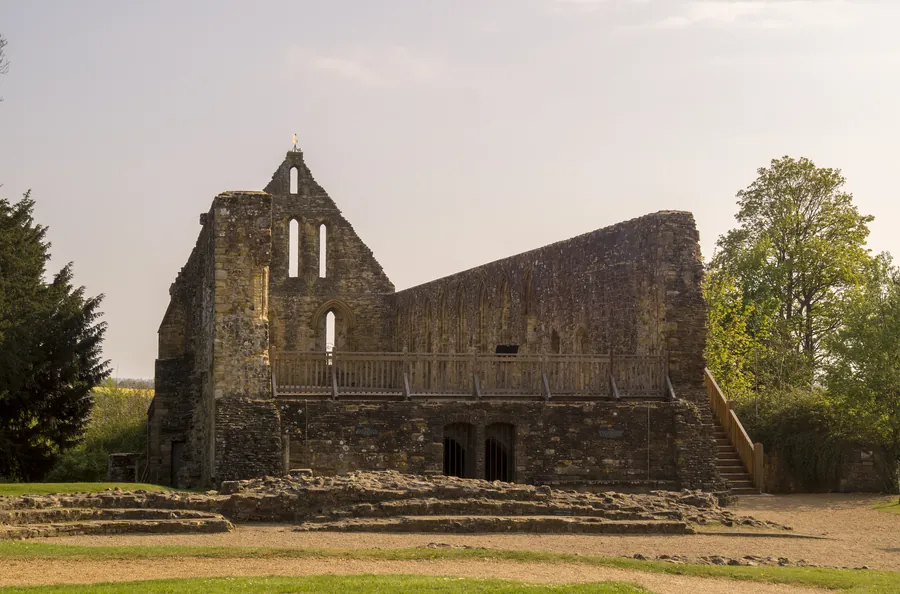
The Battle of Hastings was not fought at Hastings. It was fought nine kilometres inland, on a ridge that had no name, and the town of Battle grew up afterwards around the abbey founded on the site.
This is that ground, and English Heritage’s presentation of it — the battlefield trail, the visitor centre and the exhibition — is what most people actually come for.
14 October 1066.
Harold Godwinson had been king for nine months. In September he beat a Norwegian invasion at Stamford Bridge near York, then marched his army 400 kilometres south in under a fortnight on hearing that William of Normandy had landed at Pevensey.
He took the ridge — high ground, with marshy land in front and the flanks protected — and formed the shield wall: infantry, packed, with axes and spears. William had cavalry and archers and had to attack uphill.
The fighting lasted most of a day, which was exceptionally long for a medieval battle and tells you how close it was. The Norman line wavered early and a rumour ran that William was dead; he raised his helmet to show his face. Part of the English right pursued a retreating Breton contingent down the slope and was cut off and destroyed — after which, in the accepted reading, the Normans used feigned retreats deliberately to draw more of the wall out.
Harold was killed towards evening. The tapestry shows a figure with an arrow in the eye and a figure cut down by a horseman; which is Harold, or whether both are, has been argued over for centuries.
The shield wall broke, and England changed hands.
The battlefield trail runs from the visitor centre round the ridge and down the slope the Normans attacked up. It is the point of the visit.
The included audio guide is genuinely excellent — visitors single it out repeatedly, and the reason is that it is positional: it tells you what stood where you are standing and what was coming towards you. Standing on the line of the shield wall looking down the slope does more than any amount of reading.
Allow two to three hours for the trail, the exhibition and the abbey.
There are two routes, a longer full circuit and a shorter one, plus a viewing terrace for those who cannot manage the field.
The rebuilt visitor centre covers the succession crisis of 1066, the three claimants, the two invasions, the armies and the equipment, with a film. It is strong on what the sources actually say and where the tradition is uncertain — including the arrow in the eye, the exact position of Harold’s death and the reliability of the Bayeux Tapestry as evidence.
There are hands-on displays and a children’s activity trail, and the site does very well with primary-age children.
Admission covers the battlefield, exhibition and abbey; free to English Heritage members. Book online in summer.
Time: two to three hours.
Facilities: café, shop, toilets, picnic areas.
Access: the battlefield is a grass field on a slope and can be muddy — walking shoes. The short route and the viewing terrace are the accessible options.
Events: re-enactments through the year, with a large-scale battle re-enactment each October around the anniversary.
Getting there: Battle station is five minutes’ walk, fifteen minutes by train from Hastings.
No — nine kilometres inland, on the ridge where the town of Battle later grew up around the abbey.
Yes, and it is one of the best English Heritage produces — it works by position around the battlefield trail.
Two to three hours for the trail, exhibition and abbey.
Yes — there is a children’s trail and hands-on material, and the battlefield walk works well from primary age.
There are events through the year, with a large-scale battle re-enactment each October near the anniversary.