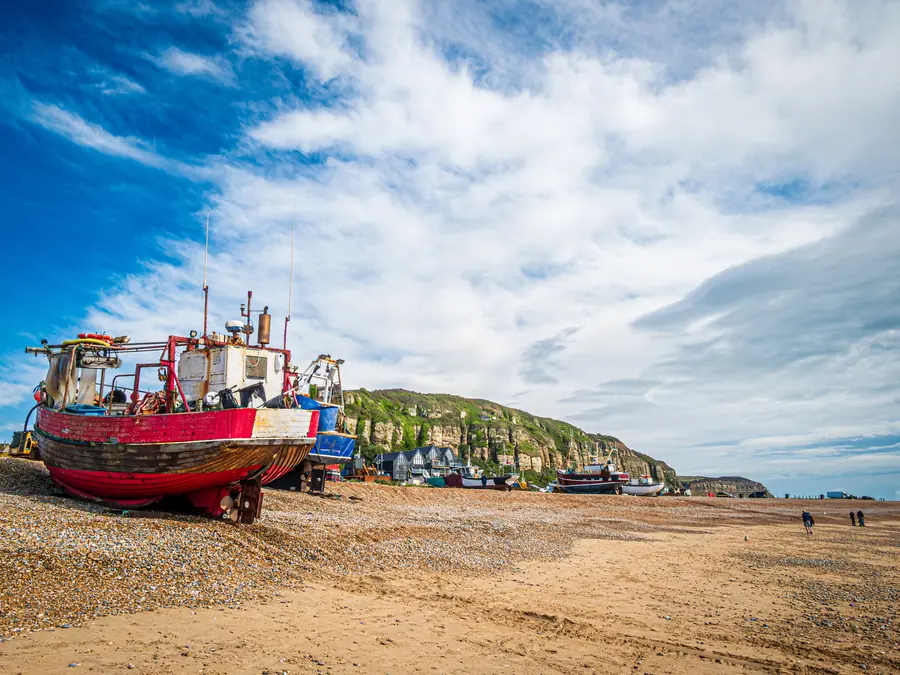
Hastings beach runs continuously for about four kilometres from Rock-a-Nore in the east to St Leonards in the west, and it is shingle — steep, coarse and grey, in the classic Sussex manner.
It has a good deal more character than most, for one reason: at the eastern end it is still a working beach.
The Stade — the Saxon word for a landing place — is the shingle at Rock-a-Nore where Hastings’s fishing fleet is drawn up.
It is the largest beach-launched fishing fleet in Europe. Hastings has never had a lasting harbour — several attempts were made and the sea took all of them, and the half-built Victorian harbour arm is still visible west of the pier — so for a thousand years the boats have been winched up the shingle instead.
The boats are short and flat-bottomed by necessity, and they go out for sole, plaice, cod, herring, mackerel and cuttlefish. Fish is sold straight off the beach from the huts, and it is as fresh as fish gets in England.
Behind the boats stand the net shops: tall, narrow, black tarred wooden towers, some three storeys, built to store nets on the smallest possible footprint because ground rent was charged by area. They date largely from the nineteenth century, there are around forty left, and there is nothing else like them anywhere in the world.
Shingle, steeply shelving, with sand exposed at low tide in places — which is when to bring small children.
Water quality is generally good and the beach is used throughout the summer. Lifeguards patrol the central section in season; the ends are unpatrolled. The shelf means the water gets deep quickly, and there can be a strong longshore drift.
Beach shoes make a real difference on the pebbles.
Dogs: restricted on the central sections in summer, allowed at either end and all year on the outer stretches. Check the signs.
Hastings Pier, rebuilt after the 2010 fire and reopened in 2016, won the Stirling Prize for its architecture — a deliberately near-empty deck rather than a pier full of attractions, which divides opinion and is superb to walk on.
The seafront promenade runs the whole length, level, with Hastings Miniature Golf — three courses — near the centre.
Bottle Alley at St Leonards, a covered lower promenade decorated with broken glass by the borough engineer Sidney Little in the 1930s, is an oddity worth walking through.
The Old Town — George Street and All Saints Street — is behind the eastern end and is the best part of the town: timber-framed houses, independent shops, pubs and antique dealers.
Free, open at all times.
Parking: several seafront car parks and on-street parking, which is paid via the RingGo app and works well. The Rock-a-Nore car park is the one for the fishing beach and the museums.
Facilities: toilets, cafés, beach kiosks along the front; everything you need in the Old Town.
Busy: bank holidays and hot weekends are very busy. Weekday mornings are not.
Access: the promenade is level throughout; the shingle is not.
Shingle, with some sand exposed at low tide.
Yes. Lifeguards patrol the central section in season; the beach shelves steeply.
Net shops — nineteenth-century net stores built tall and narrow because ground was rented by area. There are around forty and they are unique to Hastings.
Yes, from the huts on the Stade, straight off the boats.
There are several seafront car parks and on-street bays, paid through the RingGo app.