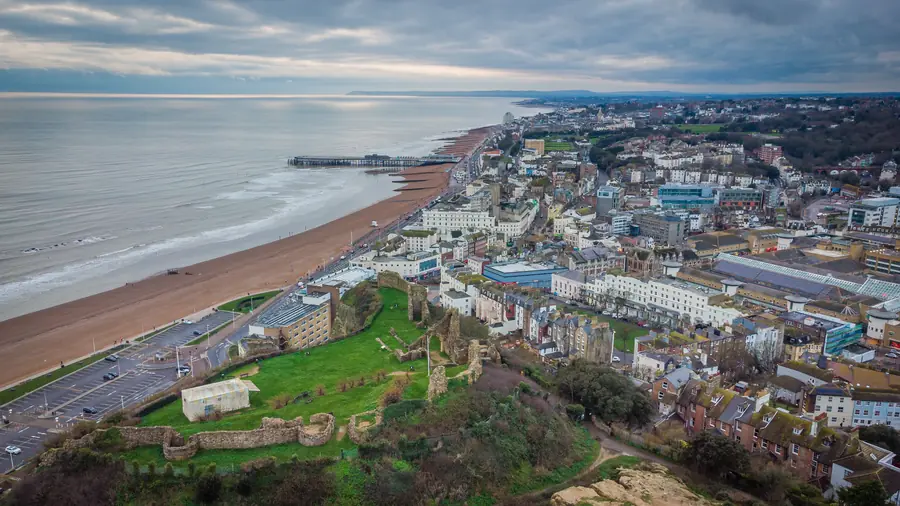
Hastings Castle stands on the West Hill, not the East, on a cliff that has been falling into the Channel for nine hundred years. It has a strong claim to being the first castle the Normans built in England. What you visit is a fragment: walls, a gateway, the outline of a chapel, grass, and a view that does more work than the masonry.
It is not English Heritage. Battle Abbey is English Heritage, thirteen kilometres inland, on the ridge where the battle was actually fought. The castle above Hastings is run independently, at hastingscastle.org.uk. Different tickets, different season, different hill.
William landed at Pevensey on 28 September 1066, moved along the coast to Hastings, and threw up a timber castle — shipped in sections, according to the usual reading of the Bayeux Tapestry, which shows a mound being dug and a palisade going up. The stone castle followed from about 1070: a motte-and-bailey on the cliff, with a collegiate church of St Mary inside the walls.
Hastings was the base. The battle was not fought under these walls. Harold’s army met William on Senlac Hill, at the place now called Battle, on 14 October. The castle’s job was to hold the landing and the road, not to host the fighting. Standing on the West Hill and looking inland, that geography is the whole 1066 story in one view: sea, camp, and, beyond the next ridge, the field.
What survives is the eastern side of the circuit, the gateway, fragments of the chapel, and rock-cut chambers that get called dungeons. The keep — if it stood where you would expect a keep to stand — has most likely gone over the cliff.
Two reasons, both finished.
The sea. The castle was built on a cliff of soft sandstone, and the cliff has been retreating ever since. Great storms in the thirteenth century took a large part of the fabric at once. More has gone since. You are looking at what the Channel has not yet claimed.
King John. In 1216, expecting a French invasion, he ordered the castle slighted so that it could not be used against him. It was partly rebuilt, then declined. By the sixteenth century it was a farm with a ruin on it. The Victorians rediscovered it as a curiosity, excavated, and opened it as an attraction.
The site is a scheduled ancient monument. Some walling is shored or fenced. Do not climb the masonry. Children need watching near the overgrowth; the cliff edge is beyond it.
It is a ruin, and a small one. Allow forty-five minutes to an hour, longer if you sit. The grounds are grass, uneven, open to the sky. There is no keep to go inside. There is a circuit of wall, the chapel outline, the gateway, and benches that exist because the view is half the ticket.
The operator now runs the place as a ruin, a lookout and an events space — history tours, the occasional performance, community use. Check what’s on if you are combining a visit with a specific evening. General admission can close for an event; booking ahead is how you avoid a shut gate.
Do not come expecting a reconstructed royal apartment. Come expecting wind, stone, and the town laid out below like a map. Wildlife has moved in during the quiet years; that is part of the visit now.
The West Hill rises steeply from the Old Town. Doing it on foot from George Street is a real climb. There are three honest ways up.
The West Hill Lift from George Street: a Victorian funicular in a tunnel, opened 1891, original wooden cars. The council lists it daily year-round — summer 10am–5.30pm, winter 11am–4pm on the cliff railways page. It has had emergency closures. It is not wheelchair accessible; pushchairs need folding. This is the lift for the castle. It is not the East Hill Cliff Railway, which starts at Rock-a-Nore and goes to the country park.
On foot from the Old Town, or a longer step-free walk from Hastings station up Castle Hill Road — the operator quotes about fifteen minutes from the station without steps, and about ten from George Street with them. See walks around Hastings.
By car, to Castle Hill Road car park: small, a block of reserved bays you cannot use on an ordinary ticket, and it fills. On-street metered bays on the same road are limited. Pelham Place and Rock-a-Nore are the large seafront parks if the hill is already full. Details in the parking guide. A large van does not belong on this slope.
This is the other half of the ticket, and it is not oversold.
From the walls you look over the Old Town roofs, the Stade and the net shops, the whole sweep of Hastings beach through Pelham to the pier and on into St Leonards, and the Channel. On a clear day Eastbourne sits to the west. The East Hill rises opposite, country park on top, fishing beach at its foot. You can read the town from here: medieval valley, Victorian resort, working shingle, two funiculars.
Late afternoon is the light. Early morning is the empty hill. A south-westerly is the wind. There is almost no shelter. Dress for it.
The West Hill grassland around the ticketed ruin is public. The Ladies’ Parlour green, the clifftop paths, the drop into the twittens — you can use the hill without buying a castle ticket. The ruin and the best of the seaward wall are inside the gate.
Under the West Hill, a few minutes from the castle, St Clement’s Caves hold Smugglers Adventure: a real sandstone network used in the eighteenth-century contraband trade, now a ticketed walk with tableaux and sound. It is the indoor half of a West Hill day, and the wet-weather standby. It does not close with the castle.
Do the caves when the ruin is a gale, or do both and take the lift down. The True Crime Museum is under the seafront, not under this hill; different ticket, different audience.
The East Hill is the other climb, and the other lift. If you have already done the castle, the East Hill is the country park and the view over the fleet, not a second castle. A morning on one hill and an afternoon on the other is a full Hastings day, with the Old Town in between.
This is the confusion that wastes a morning.
The Battle of Hastings was not fought at Hastings Castle. It was fought at Battle. William founded an abbey on that field, with the high altar reportedly on the spot where Harold fell. English Heritage runs the gatehouse, the monastic ranges, the visitor centre and the battlefield walk. Members go free there. They do not go free here.
A castle morning and an abbey afternoon is a good 1066 day if you have a car or the train — Battle is about twenty minutes from Hastings station — but they are two sites, two tickets, two car parks. Do not drive back to Rock-a-Nore between them. Our 1066 guide is the abbey document. This page is the clifftop.
Pevensey, where William landed, is a third point on the same story, thirty kilometres west. The day trips piece covers the wider circuit.
Tickets are sold on the operator site and at the gate. Booking ahead is the operator’s own advice, especially in summer and around events. An adult ticket was listed around £6.95 on the 2026 booking page — check the live page; it moves. Under-fives, family tickets and a Hastings-residents rate are listed there too.
The advertised 2026 season is 30 April to 30 October, daily 10am–5pm, last entry 4.30pm, bank holidays open. Closed in winter. Check hastingscastle.org.uk before you travel. Weather can cancel. It is a completely open-air site. There is no shelter. Refunds for rain are not the policy unless the site is actually closed as unsafe.
Dogs are not permitted on the castle site — it sits in an exclusion zone. The hill around it is a different question; the castle gate is not.
Access: a ramp to the entrance, then two small steps. Grounds bumpy and uneven. Toilets are on site, including a disabled cubicle. Cold drinks at the ticket office; the West Hill kiosk around the corner does hot drinks and food. The West Hill Lift is not the wheelchair route. The step-free walk from the station up Castle Hill Road is the one the operator describes.
May, once the season has opened: longer days, Jack in the Green on the West Hill at the bank holiday — the parade ends up here — and a town that is not yet August. Confirm the 2026 Jack dates in when to visit; the main parade is the Monday.
September for clear air and fewer people on the walls. A weekday morning in any open month for an empty ruin. A clear winter day is the longest view, and the gate is shut — walk the public hill instead. A gale is magnificent and slightly alarming: hold on to hats, keep off the fenced edges, and if the operator has closed, believe them.